
Making a good first impression online is now a business imperative, not a choice. 81% of customers look for a product online before purchasing it; hence, your website acts as the digital storefront, influencing public opinion. A good website increases search visibility, boosts leads, enhances credibility, and usually turns out to be among your most affordable marketing resources. It also elevates your brand.
Today, web development extends well beyond basic corporate websites. Businesses now depend on modern e-commerce ecosystems, progressive web apps (PWAs), bespoke dashboards, content management systems (CMS), automation-driven gateways, and sophisticated application architectures. But constructing, scaling, and upkeep of these solutions call for specialist engineering expertise; thus, employing an in-house crew for every skill is not always realistic.
This is where the strategic advantage becomes clear when businesses outsource web development. Outsourcing enables faster execution, access to specialized talent, reduced costs, flexible scaling, and lower operational overhead. When done right, it evolves into a long-term partnership that drives innovation and accelerates growth.
This guide discusses how outsourcing web development might enable your company, available development options, how to pick the best partner, what the end-to-end process entails, and how Dependibot offers dependable outsourced web engineering with accuracy and credibility.
Key Takeaways
- Outsourcing web development gives companies cost savings, flexibility, and access to specialized global talent.
- Common web solutions include corporate sites, e-commerce platforms, APIs, CMS-driven websites, and PWAs.
- Choosing the right vendor involves evaluating expertise, communication, reviews, processes, and project compatibility.
- The web development life cycle involves discovery, design, development, testing, deployment, and support.
- Dependibot offers professional, scalable, and business-focused web development outsourcing tailored to modern needs.
How to Find the Right Web Development Outsourcing Partner
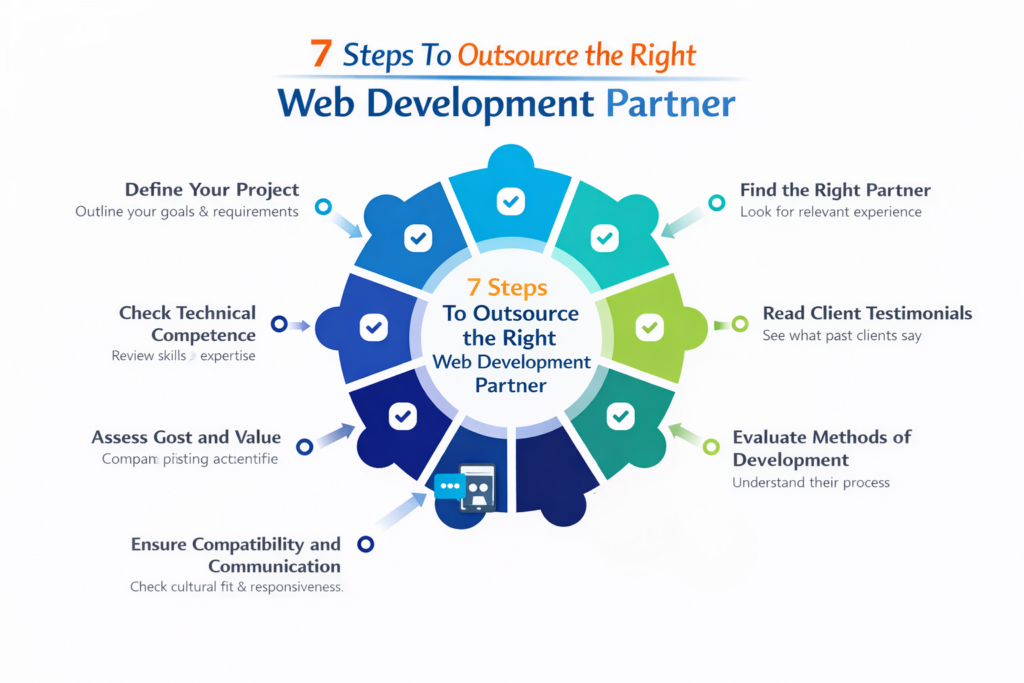
Choosing the right outsourcing partner is one of the most crucial decisions you will make during your web development journey. A dependable vendor can boost your project’s success, improve delivery timelines, and ensure consistent product quality. On the other hand, selecting the wrong partner can lead to delays, unnecessary costs, and an experience full of miscommunication and frustration. To make the right choice, you need a clear, structured, and practical framework that guides your evaluation from the start.
1. Define Your Project
Knowing your project inside and out is crucial before you approach suppliers. Smooth outsourcing depends on your inside clarity. Start by defining your primary company objectives, then explaining what you hope the website or web application will accomplish. Determine your users, the challenges the solution must address, and the most important characteristics your platform ought to include. Should you have any optional or future characteristics to bear in mind, include those as well.
Recording your timeline expectations, desired performance standards, and favourite technologies helps vendors provide precise estimates. Adding user stories, flowcharts, or basic mocks helps to dispel uncertainty even further. This first clarity guarantees the seller completely gets your concept and can so match their approach.
2. Find the Right Partner
Once your scope is ready, you should next investigate possible partners via reputable platforms. Verified information on a vendor’s ability, past, and reliability comes from marketplaces including Clutch, GoodFirms, Upwork, Behance, and even LinkedIn. These sites enable you to view thorough portfolios, peruse genuine client reviews, and grasp the sectors each firm has served.
Looking at these profiles will help you to limit your attention to providers that exhibit consistency, enduring client connections, and a clear history of producing successful projects. Having a limited number of well-known companies makes later, more in-depth analyses easier to approach.
3. Check Technical Competence
Any successful web development initiative pivots on technical competence. Evaluate whether the team of shortlisted companies possesses the engineering prowess needed to make your project come to life as you start interacting with them. Request code examples as needed, examine their technical certifications, and ask for case studies highlighting related work.
You can either set a real-world task linked to your project or hold a technical interview with their developers. Their technical maturity will be more clearly seen when you see how they approach a challenge, dissect it, and how inventive or scalable their answers are. This phase guarantees the vendor is really able to create a contemporary, secure, and ready-to-scale solution rather than only experienced.
4. Read Client Testimonials
Often, the best indicator of what you can anticipate from a supplier is their previous work. Looking back at past projects helps you to grasp their design aesthetic, growth standards, and the kinds of sectors they are acquainted with. Selecting a companion who has already been working on systems comparable to yours can greatly lower hazards since they are already aware of the possible problems and ideal solutions for those networks.
Client testimonials count as much. They show how the vendor communicates, reacts to criticism, and whether they satisfy deadlines. Honest evaluations also reveal the degree of professionalism of the vendor as well as their capacity to assist customers following launch. Open, fair comments from well-known consumers point to dependability and excellent customer satisfaction.
5. Evaluate Methods of Development
Every professional supplier follows a certain growth strategy that shapes the general project experience. A great conversation about their workflow helps us to understand their sprint setup, their update frequency, their testing process, and code review management. Typically, regular demonstrations, sprint reviews, and frequent contact offer a vendor employing Agile or Scrum greater transparency.
Your project will grow in expected phases with a systematic plan, enabling you to track progress, provide input, and ensure team alignment. It also guarantees a professional and flawless working relationship by reducing the probability of misunderstandings or unexpected delays.
6. Assess Cost and Value
Though cost is important, it should never be the only consideration. Rather than picking the least expensive choice, concentrate on the general value the supplier offers. Think about how scalable their solution will be as your company expands, whether they provide maintenance and support, and whether their pricing strategy is clear. Honesty and professionalism are shown by clear pricing devoid of secret charges.
Consult your legal counsel before signing any agreement. The agreement has to clearly specify the scope, deliverables, payment schedules, ownership of the intellectual property, dispute-resolution processes, and termination conditions. A clearly written contract establishes the tone for a successful long-term collaboration as well as safeguards both parties.
7. Ensure Compatibility and Communication
Excellent teamwork depends on excellent communication. Because outsourcing usually entails distant cooperation, it is imperative to guarantee that the supplier is respectfully, consistently, and clearly communicating. Talk about the communication methods they utilise, Slack, Microsoft Teams, email, or project management software, and settle on the frequency of your updates.
Compatibility of time zones also helps a lot. Beyond logistics, evaluate cultural fit and whether the vendor demonstrates a cooperative attitude. Overlapping hours hasten feedback loops and cut down on delays. Your project moves more quickly, issues are resolved sooner, and the whole partnership seems easier and more effective when communication flows clearly.

Key Services You Can Outsource to Web Development Partners
When outsourcing web development, businesses are not limited to just coding a website. Modern outsourcing partners offer end-to-end services that cover the entire digital product lifecycle. Depending on your goals, you can outsource one specific task or an entire project.
1. Frontend Development
Frontend development focuses on everything users see and interact with. This includes responsive layouts, user interfaces, animations, and accessibility. Outsourced teams use modern frameworks like React, Vue, or Angular to create fast, engaging, and visually consistent experiences across devices.
2. Backend Development
Backend development handles the logic that powers your website or application. This includes server-side programming, databases, authentication systems, APIs, and integrations. Outsourcing backend development ensures your system is secure, scalable, and capable of handling real-world traffic and data loads.
3. Full-Stack Software Development
Full-stack development combines both frontend and backend expertise. By outsourcing full-stack software development, businesses can rely on a single team to manage the entire application architecture, reduce coordination gaps, and speed up delivery for complex projects.
4. UI/UX Design
A strong user experience directly impacts engagement and conversions. Web development partners can handle user research, wireframing, prototyping, and visual design to ensure your product is intuitive, visually appealing, and aligned with user behaviour.
5. Web Application Development
Outsourcing web application development allows businesses to build secure, scalable, and feature-rich platforms such as dashboards, SaaS products, portals, and internal tools. These applications are designed for performance, long-term scalability, and seamless user interaction.
6. E-commerce Development
From custom online stores to complex marketplaces, outsourcing partners can build and manage e-commerce platforms. Services often include payment gateway integration, product management, order workflows, inventory systems, and performance optimisation for high traffic.
7. CMS Development and Customisation
Outsourcing CMS development allows businesses to easily manage content without technical help. Partners can build, customise, or migrate CMS platforms such as WordPress, headless CMS solutions, or custom content systems tailored to your workflow.
8. API Development and Integrations
APIs are essential for connecting systems, automating processes, and enabling data exchange. Outsourced teams can develop REST or GraphQL APIs, integrate third-party tools, and connect your web platform with CRMs, ERPs, payment providers, or analytics systems.
9. Mobile App Development
Many web development partners also provide mobile app development services. This includes building cross-platform or native mobile apps that integrate smoothly with your web systems, ensuring a consistent experience across devices.
10. Quality Assurance and Testing
Many companies outsource quality assurance to ensure consistent performance and reliability. This includes functional testing, usability testing, security testing, performance testing, and cross-browser compatibility checks before and after launch.
11. DevOps Services
DevOps services support faster deployment, better system stability, and improved scalability. Outsourcing DevOps includes CI/CD pipelines, cloud infrastructure setup, monitoring, automated deployments, and security best practices to keep applications running smoothly.
12. Maintenance and Ongoing Support
Web development doesn’t stop after deployment. Outsourcing partners often provide continuous support, security updates, performance monitoring, bug fixes, and feature enhancements to keep your website or application stable and competitive.

Types of Web Development Outsourcing Models
Choosing the right outsourcing model is just as important as choosing the right partner. Different models offer different levels of control, flexibility, and cost efficiency. The best choice depends on your project scope, budget, and long-term plans.
1. Fixed-Price Model
In the fixed-price model, the project scope, timeline, and cost are defined upfront. This model works best for small to medium projects with clearly defined requirements. It offers predictable costs but limited flexibility if changes are needed later.
2. Time and Material Model
This model is ideal for projects where requirements may evolve. You pay based on the actual time and resources used. It provides greater flexibility, transparency, and adaptability, making it suitable for long-term or complex projects.
3. Dedicated Team Model
With a dedicated team model, you hire a team of developers, designers, and QA engineers who work exclusively on your project. This model offers maximum control, strong collaboration, and long-term scalability, making it ideal for ongoing development or product-based businesses.
4. Staff Augmentation
Staff augmentation allows you to extend your in-house team with external developers who fill specific skill gaps. This model works well when you need extra resources quickly but want to keep project management internal.
5. Offshore, Nearshore, and Onshore Outsourcing
- Offshore outsourcing offers cost advantages by working with teams in distant regions.
- Nearshore outsourcing provides closer time zones and cultural alignment.
- Onshore outsourcing involves working with teams in the same country, offering easier communication but often at higher costs.

Contemporary Forms of Web Solutions For Your Business
Before you outsource, you need clarity on what you want to build. Modern businesses use websites and apps in many forms, and each type solves a different set of problems.
Below are the major categories of web solutions you can outsource:
1. Corporate and Business Websites
These are foundational tools for your digital presence. They communicate your brand story, highlight services, build trust, and serve as a central point of customer interaction.
2. E-commerce Websites and Online Stores
E-commerce platforms enable businesses to sell products securely and efficiently. Outsourced teams can build:
- Custom carts
- Secure checkouts
- Product management systems
- Payment gateways
- Inventory and shipping integrations
With online shopping booming, a professionally built e-commerce website directly contributes to sales growth.
3. Web Services & APIs
APIs enable systems to talk to each other, something essential in today’s interconnected digital environment. Outsourced developers can build:
- RESTful APIs
- GraphQL APIs
- Third-party integrations
- Automation scripts
- Internal dashboards
These unlock new features without replacing entire systems.
4. Content Management Systems (CMS)
CMS platforms such as WordPress, Strapi, Craft CMS, and headless CMS frameworks help businesses manage content more efficiently. They’re ideal if you need regular content updates without technical assistance.
5. Progressive Web Apps (PWAs)
PWAs function like mobile apps but run directly in a browser. They offer:
- Offline browsing
- Fast loading
- Push notifications
- Native app-like experiences
They are perfect for e-commerce, news portals, communities, and SaaS platforms.
Why Dependibot is the Ideal Partner for Web Development Outsourcing
Backed by expertise and excellence, Dependibot aims to deliver high-performance, scalable, and secure web development solutions. Combining technical competence with a business-driven approach enables our customers to trust us.
Dependibot is distinguished by:
1. Proven Track Records of Expert Web Developers
Experienced engineers, designers, and architects on our staff may realise even the most intricate ideas.
2. Transparent Operations and Predictable Delivery
Modern development criteria guide us and keep you informed every step of the way.
3. Business-Driven Approach
Before starting any work, we investigate your objectives, target audience, sector, and competitive environment.
4. Quick Onboarding and Scalable Flexibility
Whether one developer or several teams, we grow according to your requirements.
5. Long-Term Help and Top-Quality Code
We provide secure, maintainable, performance-optimised solutions.
6. Cooperation Beyond Development
Dependibot aids companies in expanding via careful strategy and constant optimisation; we not only provide websites.
Dependibot gives you the dependability, knowledge, and commitment required, whether you are a new venture releasing your first product or a company upgrading ancient systems.
Conclusion:
More than just coding, a full web development process is a systematic journey starting with knowledge of your company’s demands and terminating in the delivery of a refined, high-performing digital product. Each stage, from finding and creating through development, deployment, and continuing maintenance, guarantees your website is dependable, user-friendly, and in line with your long-term objectives. Rightly executed, this workflow reduces risks, enhances cooperation, and guarantees every feature is deliberate. Following a well-defined end-to-end process enables companies to create scalable, safe, and future demand-growing digital solutions.
FAQs
Q1. Is outsourcing web development still a viable solution in 2026?
Yes. Outsourcing is still one of the most efficient means to get specialised personnel, cut overhead, and speed digital product releases, given growing developer expenses in Europe and the United States. Modern outsourcing partners stress cultural fit as well as fair pricing and long-term scalability.
Q2. How do I ensure quality when outsourcing web development?
Define precise project objectives, communicate frequently, and ask for progress reports or demonstrations. Examining their previous work and setting milestones helps keep up standards.
Q3. What are the typical hazards of web development outsourcing?
Misunderstandings, missed deadlines, or expectations not aligned are all possible dangers. Selecting a dependable partner, drafting explicit contracts, and remaining engaged in the process will help to minimise these risks.
Q4. Normally, how long does it take to finish an outsourced web development project?
Depending on features, complexity, and team size, project schedules vary. Simple websites can take a few weeks; intricate web applications can take several months. Before beginning, always negotiate deadlines.