
Running a company nowadays means relying more on technology than we ever have. From cloud storage and email to cyber security and remote access, IT touches virtually every area of daily activity. Handling IT in-house, however, is difficult, pricey, time-consuming, and frequently drives business owners to respond to issues rather than stop them.
That’s where Managed IT Services provide help. Managed IT services are, in other terms, continuous IT administration and assistance provided by a third-party vendor, known as a Managed Services Provider (MSP). Unlike the traditional ‘break/fix’ paradigm, where you await something to malfunction and then summon an IT professional, MSPs use a proactive strategy of surveillance, securing, and maintaining your systems around the clock.
Particularly for small and mid-sized companies, this proactive approach helps to minimize downtime, reinforce cybersecurity, and release time to concentrate on expansion rather than endless technological issues.
History of Managed IT Services
Managed IT services have undergone a revolutionary metamorphosis during the past few decades.
- Companies either built their own internal IT teams or used the break/fix approach, calling on outside specialists only if something went wrong.
- Emerging in the 1990s, remote monitoring technologies allowed IT professionals to track system performance and spot problems before they became disruptive.
- Subscribed systems replaced irregular repair bills with set monthly costs, hence growing in popularity in the 2000s.
- Today, MSPs offer a range of services beyond just data recovery, compliance, security, and long-term IT plans, including cloud management.
Managed IT services for finance companies and other industries have become a strategic growth driver for businesses instead of simply being responsive. Businesses looking forward to optimizing system reliability and deployment efficiency often merge these services with DevOps services to transform operations.
What is a Managed Service Provider (MSP)?
A Managed Service Provider (MSP) is the company that delivers managed IT services. Think of them as your outsourced IT department.
Typical MSP Roles:
- Monitoring your network 24/7 to prevent outages.
- Troubleshooting issues before they disrupt operations.
- Securing systems against cyber threats.
- Optimizing IT infrastructure for performance and scalability.
MSPs vs. IT Consultants
While IT consultants generally work on short-term, project-based assignments (like setting up a new CRM), MSPs provide ongoing, long-term support. They stay with your business month after month, ensuring stability and growth.
Industries That Rely on MSPs
- Healthcare → compliance with HIPAA and patient data protection.
- Finance → secure transactions and SOC 2 compliance.
- Retail & E-commerce → uptime and customer data protection.
- Startups & SMBs → affordable access to expert IT support without hiring full teams.
9 Types of Managed IT Services
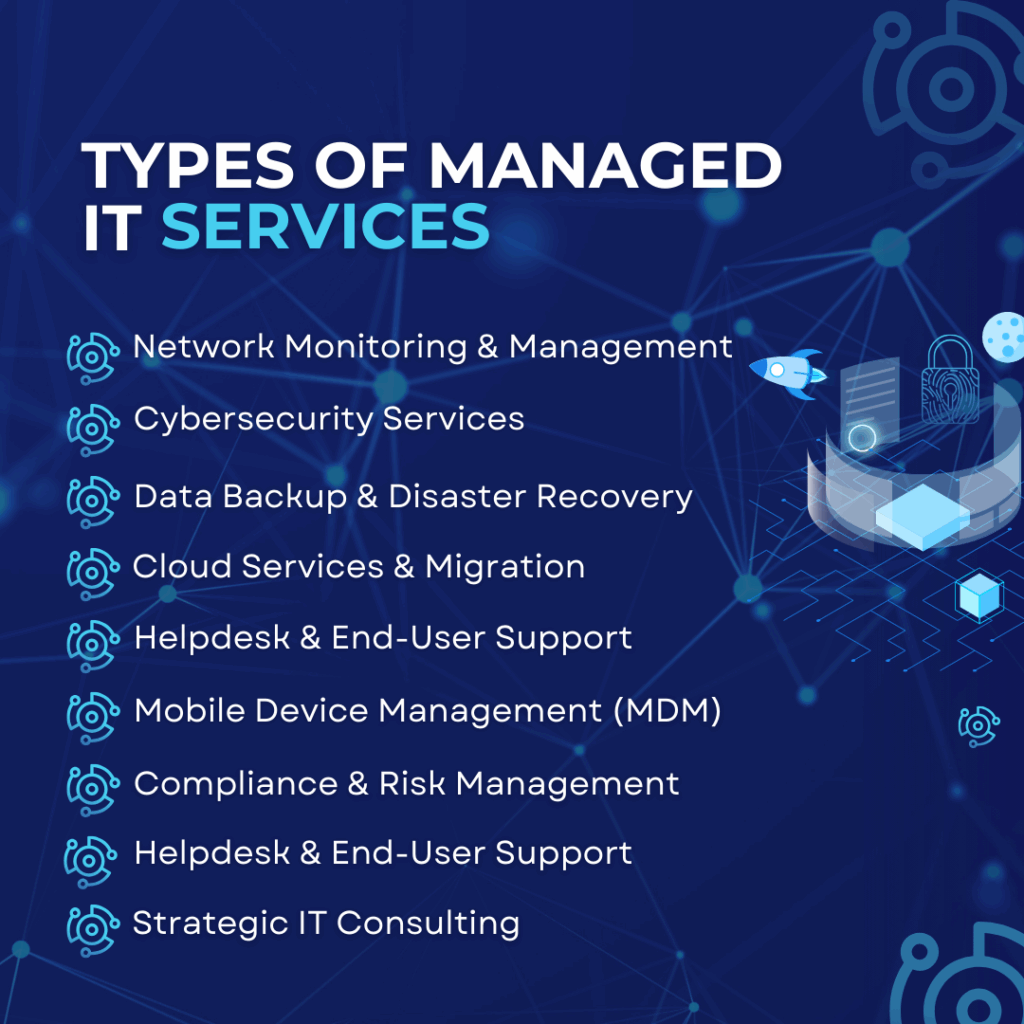
MSPs offer a broad spectrum of services depending on business needs. Their contemporary forms of integration with business analytics enable businesses to leverage data-driven insights while enabling safer and optimized technology infrastructure. Common categories include:
1. Network Monitoring & Management
- Ensures networks run smoothly, with maximum uptime.
- Detects and resolves performance issues proactively.
2. Cybersecurity Services
- Firewalls, antivirus, and advanced threat detection.
- Protects against phishing, ransomware, and malware.
3. Data Backup & Disaster Recovery
- Automatic backups and recovery plans.
- Keeps businesses operational after data loss, cyberattacks, or natural disasters.
4. Cloud Services & Migration
- Moving data and applications to the cloud (AWS, Azure, Google Cloud).
- Ongoing management of cloud environments.
5. Helpdesk & End-User Support
- 24/7 IT helpdesk for staff.
- Solves issues like login errors, email problems, and software glitches.
6. Mobile Device Management (MDM)
- Secures company laptops, smartphones, and tablets.
- Prevents unauthorized access if devices are lost or stolen.
7. Compliance & Risk Management
- Ensures IT practices meet industry regulations (HIPAA, GDPR, SOC 2).
- Regular audits and reporting.
8. Software Updates & Patch Management
- Keeps systems current and secure.
- Reduces vulnerabilities from outdated software.
9. Strategic IT Consulting Services
- Aligns IT with business goals.
- Helps SMBs plan for future growth and digital transformation.
You May Also Like: How Dependibot Transforms Ideas into Mobile Apps
Managed IT Service Advantages
1. Cost Efficient
One of the main benefits of managed IT services is price predictability. Companies pay a fixed monthly fee that includes continuous monitoring, maintenance, and support instead of purchasing emergency repairs when something goes wrong. This subscription approach removes the surprise of excessive repair charges and simplifies budget planning. Additionally, lowering overhead, it frees you from having to keep a full in-house IT staff or pay for costly one-off consultations.
2. Accessibility to Expertise
Most small and medium-sized businesses would find hiring a complete IT department with expertise in cloud, networking, security, and compliance beyond their means. An MSP gives you access to a group of specialists spanning many fields, all covered in your service plan. This implies that your firm gains from enterprise-level abilities and knowledge without the cost of employee hiring, training, and retention. You basically access a wider skill set than most SMBs could ever afford.
3. Stronger Security for Computer Systems
One of the major dangers SMBs face now is cyberattacks. Small companies are actually the targets of about half of all cyberattacks. MSPs offer ongoing, proactive security monitoring that finds flaws before attackers can abuse them. They also maintain system security by means of routine updates, patch management, and risk assessments. Outsourcing enables you to access sophisticated security solutions like next-generation firewalls and intrusion detection systems that several SMBs would not be able to justify buying independently.
4. Scalability
Your IT requirements rise with your company’s growth. Managed IT solutions are meant to grow alongside you. Your MSP can easily change your service plan whether you’re bringing in new employees, expanding locations, or seeing seasonal demand spikes. This flexibility guarantees you always have the right level of support and never overpay for resources you don’t use. It also frees you to grow without the delays and costs of hiring more IT personnel.
5. Reduced Downtime
One of the biggest advantages of partnering with an MSP is minimizing downtime. With proactive monitoring, routine maintenance, and strong security practices, MSPs keep your systems running smoothly and reliably. And if issues do occur, dedicated teams of engineers are available around the clock to resolve them quickly and prevent prolonged disruptions.
6. Concentrate on Core Business
For most SMBs, technology is necessary but not the center of their operations. Not on solving IT issues, business leaders want to concentrate on innovation, customer service, and expansion. Outsourcing to an MSP frees your internal team from having to handle technical problems. This frees leadership and workers to concentrate their time and energy on strategic business projects, leaving IT administration to experts.
Pricing for Managed IT Services:
- Most MSPs employ subscription-based designs. Pricing may vary on:
- Per-User or Per-Device Fees: flat rate per staff member or machine.
- Tiered Packs: basic, standard, premium service levels.
- Tailored to particular business needs: Customized Plans.
- Depending on services and complexity, SMBs in the US usually pay from $100 to $250 per user per month.
What’s the Difference Between Managed IT Services and Cloud Services?
- Managed IT Services = full-spectrum IT support (monitoring, security, helpdesk, compliance).
- Cloud Services = infrastructure hosting, storage, and access (AWS, Azure, Google Cloud).
Most MSPs manage cloud services as part of their packages. For example, a retail business might outsource both its IT management and cloud hosting to the same provider for seamless integration.
Who Needs Managed IT Services?
- Small to Mid-Sized Businesses (SMBs): Can’t afford large IT teams but need reliable support.
- Enterprises: Require scalable infrastructure and compliance.
- Remote & Hybrid Workplaces: Depend on secure remote access and device management.
- Regulated Industries: Healthcare, finance, and legal sectors require strict compliance.
- Startups: Want to focus on product growth without IT distractions.
Challenges of Managed IT Services (How to Overcome Them)
1. Loss of Control
Some company owners are concerned about losing control over how systems are handled through the outsourcing of IT. Giving important infrastructure to an outside provider can be seen as dangerous; hence, it makes perfect sense. Set up precise Service Level Agreements (SLAs) defining responsibilities, response times, and expected results. Regular performance reports and review meetings also promote openness so you always have knowledge about the status of your IT systems.
2. Security Concerns
Entrusting sensitive company and customer data to an MSP can raise security questions. The best way to address this is to work with certified providers that follow strict compliance standards such as SOC 2, HIPAA, or GDPR, depending on your industry. Ask for proof of their certifications, data handling policies, and security protocols. A reliable MSP will not only meet but often exceed the security measures most SMBs can manage on their own.
3. Concern about the cost
Paying a monthly charge for IT services feels pricey to some companies in comparison to the traditional “call when it breaks” strategy. Unexpected downtime, cyberattacks, or equipment failures usually cost much more than a membership, though. Businesses have to compare several pricing systems, flat rate, tiered, or customized plans, and select the one that best meets their needs to control expenses. This guarantees consistent budgeting and improved worth over time.
4. Vendor Lock-in
Becoming too reliant on one MSP is another issue since it makes it hard to change service providers later. Finding companies that provide hybrid IT solutions and flexible contracts can help one to prevent this. Some MSPs, for instance, let you maintain some of your IT in-house while they oversee particular services like cloud or security. This flexibility guarantees you maintain control if your needs change in the future and lessens your dependency.
Read More: What is Software Maintenance? Definition, Types, Process, and Why It Matters
Choosing the Right Managed IT Service Provider
Selecting the right managed IT service provider is a critical decision that can shape your company’s efficiency, security, and long-term growth. To make the best choice, keep these factors in mind:
- Alignment with Business Goals: Ensure the provider’s solutions support your overall business objectives and future growth plans.
- Technical Expertise: Look for a team with a wide range of skills in areas like networking, cloud, and cybersecurity.
- Proactive Management: Choose a provider that focuses on preventing issues through ongoing monitoring rather than just fixing problems after they occur.
- Customization: Confirm they can tailor their services to fit your company’s unique needs instead of offering a one-size-fits-all approach.
- 24/7 Technology Support: Select a provider that offers round-the-clock remote IT support so you’re never left waiting when issues arise.
Key Takeaways
- Proactive IT Management: Managed IT services replace the outdated break/fix model with continuous monitoring and maintenance, preventing problems before they disrupt business operations.
- Cost Predictability: Businesses pay a fixed monthly fee rather than unpredictable repair costs, enabling better budgeting and long-term savings.
- Access to Expertise: Partnering with an MSP gives businesses access to specialized IT professionals across networking, cybersecurity, cloud, and compliance without the cost of full-time staff.
- Enhanced Cybersecurity: MSPs offer advanced protection through firewalls, threat detection, and 24/7 monitoring, significantly reducing cyber risks.
- Scalability and Flexibility: As your business grows, managed IT services can easily scale up or down to match evolving needs.
- Reduced Downtime: Proactive maintenance and fast troubleshooting minimize outages, ensuring maximum productivity.
- Focus on Core Business: Outsourcing IT lets business leaders and teams focus on strategic goals rather than technical issues.
- Compliance and Risk Management: Certified MSPs ensure alignment with standards such as HIPAA, GDPR, and SOC 2, thereby protecting sensitive business data.
- Ideal for All Business Sizes: From startups to large enterprises, managed IT services provide affordable, secure, and scalable IT solutions.
- Dependibot Advantage: Dependibot solutions deliver proactive, AI-driven managed IT services designed to strengthen security, optimize performance, and support long-term business growth.
Final Thoughts
Managed IT services have become an essential resource for US businesses, especially SMBs. Instead of struggling with costly in-house teams or relying on outdated break/fix models, companies can partner with MSPs to access proactive, scalable, and affordable IT support. From reducing downtime to strengthening cybersecurity managed services and aligning IT with business goals, the benefits are clear.
At Dependibot, we help businesses in the US navigate digital transformation with managed IT services tailored to their needs. Our team combines IT expertise with innovation in AI, security, and consulting, ensuring that your business stays secure, efficient, and ready to grow. Whether you’re a startup or a growing SMB, Dependibot can be your trusted technology partner.
FAQs on Managed IT Services
Q1. What are Managed IT Services in Simple Terms?
Managed IT services mean handing over the day-to-day management of your IT systems to a third-party provider called an MSP. Instead of hiring a full internal IT team, the provider monitors, maintains, and secures your technology so you can focus on running your business.
Q2. How Much Do Managed IT Services Cost?
Costs are usually based on a monthly subscription, with pricing often ranging between $100 and $250 per user per month in the US. The exact cost depends on the level of service you choose, such as basic support, advanced security, or full-scale IT management.
Q3. What’s the Difference Between Managed IT Services and IT Outsourcing?
Traditional IT outsourcing is often project-based, like setting up a network or migrating to the cloud. Managed IT services, on the other hand, provide ongoing, proactive support, monitoring systems, preventing issues, and keeping your IT running smoothly every day.
Q4. Can Small Businesses Benefit from Managed IT Services?
Yes, managed IT services are especially valuable for small businesses that don’t have the budget for large IT teams. By outsourcing, SMBs get enterprise-level expertise, stronger security, and predictable costs without the overhead of full-time staff.
Q5. Are Managed IT Services Secure?
Managed IT services can be highly secure if you partner with certified providers who follow strict compliance standards like SOC 2, HIPAA, or GDPR. Many MSPs also use advanced security tools, continuous monitoring, and regular audits to safeguard your data.