Software development is the process of creating computer programs and applications that power our digital world. From the mobile apps we use daily to complex business systems that keep global companies running, software development is at the heart of innovation.
It matters because it shapes the way we communicate, shop, work, and entertain ourselves. In fact, the U.S. Bureau of Labor Statistics projects a 25% growth in software developer jobs between 2022 and 2032, much faster than the average for other occupations. This shows how essential software development has become for both businesses and individuals.
What is Software Development?
At its core, software development means designing, writing, testing, and maintaining code to solve problems or create digital solutions. Think of it as the craft of turning ideas into useful, working applications.
This field goes by different names, including programming, coding, application development, or software engineering, depending on the context. The people behind it are software developers, engineers, or programmers who combine technical skills with creativity to build solutions.
An easy way to understand this is by comparing it to building a house:
- The blueprint = requirements.
- The construction = coding.
- The inspection = testing.
- The final move-in = deployment.
Like a house, good software requires planning, careful execution, and ongoing maintenance to remain functional and secure.
3 Types of Software
Software can be categorized in many ways, but the three most common categories are:
1. System Software
System software provides the foundation for all other software. It runs in the background and allows hardware and applications to function smoothly.
- Examples: Operating systems (Windows, macOS, Linux), device drivers, and utility programs like antivirus software.
- Why it matters: Without system software, applications wouldn’t know how to interact with the computer’s hardware.
2. Application Software
Application software is what most people interact with daily. It’s designed to help users complete specific tasks or entertain themselves.
- Examples: Word processors, spreadsheets, video players, mobile apps like WhatsApp, business apps like Salesforce.
- Why it matters: Application software powers personal productivity, communication, and business operations.
3. Programming Software
Programming software is built for developers to create and test other software.
- Examples: Code editors (VS Code), compilers (GCC), debuggers, and version control systems like Git.
- Why it matters: These tools help developers write clean, efficient, and error-free code.
Together, these three categories form a layered structure: system software is the foundation, application software is what users interact with, and programming software is what developers use to create everything.
The Software Development Process (Steps Made Simple)
The process of building software is structured into steps known as the Software Development Life Cycle (SDLC). Each step ensures quality and reduces risks.
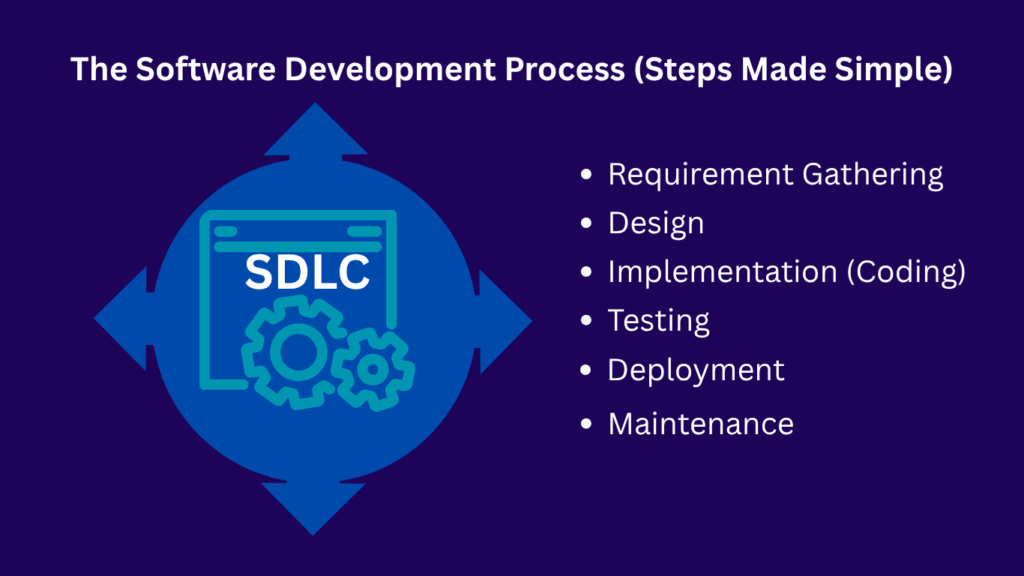
Step 1: Requirement Gathering
This is like interviewing the “homeowner” before building a house. Developers talk to stakeholders to figure out:
- What problems should the software solve?
- What features are must-haves vs. nice-to-haves?
- Any constraints such as budget, deadlines, or compliance requirements.
Step 2: Design
Here, developers create blueprints for the software. This includes:
- System architecture (how the components connect).
- Wireframes and mockups (how it will look for users).
- Database design (how data will be stored and accessed).
Step 3: Implementation (Coding)
This is the building stage where developers write code using programming languages like Python, Java, C#, or JavaScript. Depending on the project, teams may split work into frontend (user-facing) and backend (server-side).
Step 4: Testing
Testing ensures everything works as intended. Common testing types include:
- Unit testing (checking individual components).
- Integration testing (ensuring different modules work together).
- System testing (testing the full product).
- User Acceptance Testing (UAT) (validating with actual users).
Step 5: Deployment
Once the software is ready, it’s released to users. This may involve setting up servers, moving data, or publishing an app on app stores.
Step 6: Maintenance
After release, updates are necessary to fix bugs, patch security issues, and add new features. Good maintenance ensures software remains relevant and secure over time.
While some teams use the Waterfall method (finishing each step before moving on), others use Agile (working in short, flexible cycles).
You May Also Read: Best Countries To Outsource Software Development
4 Key Features of Software Development
Software development stands out because of its unique characteristics:
- Collaboration: Projects involve developers, designers, testers, managers, and clients working together.
- Creativity & Problem-Solving: Developers not only write code but also invent new ways to solve problems.
- Continuous Learning: New programming languages, tools, and trends emerge constantly; developers must keep up.
- Quality Assurance: Rigorous testing and review ensure the final product is reliable, efficient, and safe.
The Importance of Software Development in the Modern Era
Software is the backbone of modern life. Its importance can be seen in:

Innovation
Software drives innovation in fields like AI, robotics, fintech, and healthcare. For example, AI-powered apps use software to analyze data and provide recommendations.
Business Efficiency
Companies use custom software to automate repetitive tasks, manage data, and scale operations. Tools like CRMs (HubSpot, Salesforce) and ERPs help businesses operate smarter and faster.
Everyday Life
From booking a cab on Uber to streaming on Netflix, software simplifies our daily lives. It connects people, services, and products globally.
According to Statista, the global software market is projected to exceed $858 billion by 2028, highlighting its growing importance.
Careers in Software Development
Software development offers diverse career paths with high demand and attractive salaries:
- Frontend Developer: Builds user-facing parts of applications (HTML, CSS, JavaScript).
- Backend Developer: Manages servers, databases, and APIs.
- Full-Stack Developer: Skilled in both frontend and backend.
- Mobile Developer: Creates iOS and Android applications.
Supporting Roles Include:
- QA Engineers – ensure software quality.
- DevOps Engineers – manage deployment and operations.
- Software Architects – design overall system structures.
- Product Managers – align development with business goals.
The median U.S. salary for software developers was $127,260 annual wage in 2022 (BLS), making it one of the most rewarding careers in tech.
Popular Software Development Methodologies
Waterfall Method
A traditional, sequential process where each stage must be completed before moving on. It’s best for projects with clear, unchanging requirements.
- Pros: Easy to manage, structured.
- Cons: Rigid, changes are costly.
Agile Method
An iterative approach where work is divided into short “sprints.” Teams can adapt quickly to changes.
- Pros: Flexible, encourages collaboration, and provides faster feedback.
- Cons: Requires active stakeholder involvement.
Hybrid Method
Combines Waterfall’s structure with Agile’s flexibility. Businesses use this when they need both stability and adaptability.
V-Model (Verification & Validation)
This model pairs each development phase with a corresponding testing phase. For example, requirements = acceptance testing, design = system testing.
- Pros: Errors are caught early, highly reliable.
- Cons: Rigid, requires clear requirements upfront.
Conclusion
So, what exactly is software development? Design, construction, and maintenance of the instruments and technologies driving our digital society define this process. Solving problems, promoting innovation, and influencing the course of technology are all rather important aspects. It goes beyond just coding.
Software development is essential for success, whether you are a student investigating technical jobs or a company attempting to create bespoke solutions. Thriving in the digital age requires a basic knowledge of technology, as it keeps changing.
Key FAQs on Software Development
Q1. What are the Many Kinds of Software Development?
Among the many types of software development are web development, mobile app creation, desktop applications, cloud computing, game creation, embedded systems, and AI/ML solutions. Every kind has a range of applications, from running sophisticated business systems to powering websites.
Q2. What is the Software Development Cycle?
Software Development Life Cycle (SDLC), sometimes known as the software development cycle, is a systematic approach for developing software. To guarantee quality and efficiency, it comprises phases like planning, design, coding, testing, deployment, and maintenance.
Q3. Software Development’s Main Objective?
Software development seeks mostly to address issues, raise productivity, and build tools for people and companies. By transforming ideas into workable uses that serve daily life and business, it fosters invention.
Q4. What Defines a Software Development Course?
A software development course imparts to students the skills required to create applications, including programming, design, testing, and project management. These can span anything from software engineering or computer science college diplomas to internet bootcamps.
Q5. What Examples Does Software development include?
Among examples are operating systems like Windows, mobile apps like WhatsApp, web services like Netflix, and corporate systems like SAP. The development process of the software creates all of these results.
Q6. Software Development Abilities are What?
Among the crucial abilities needed in software development are programming, problem-solving, debugging, version control (as Git), and teamwork. Developing dependable and user-friendly software also requires great communication and an analytical mind.
Q7. What Defines the Software Development Cycle?
The Software Development Life Cycle (SDLC) is a methodical approach for designing, developing, testing, and maintaining software. It offers a step-by-step structure that helps developers to produce excellent apps on schedule and under budget.
Q8. What is a Software Development Degree?
A degree in software development is an official academic program, such as a Bachelor’s in Computer Science or Software Engineering. It helps students to understand programming, system design, and project management.
Q9. What is Software Engineering?
Software engineering applies engineering concepts to the process of software development. Through systematic methods and thorough testing, it aims at developing dependable, scalable, and maintainable systems.
Q10. What’s a Programmer’s Remuneration?
One of the most highly compensated industries in technology is software development. With a median annual compensation of $127,260 in 2022, according to the U.S. Bureau of Labor Statistics, software developers had one of the most satisfying jobs in the sector. Depending on their position, background, and geographic location, top earners can make substantially more.