
Are you struggling to find a custom software development company?
With so many options available, selecting a top software development company can be a challenging task. When evaluating a software development firm, many key success factors differentiate the top software development companies from others.
Let’s explore the various factors that have helped software development companies become successful.
Key Takeaways
- Your project’s success, quality, and security are directly affected by your choice of software development firm.
- Always assess a firm’s portfolio, experience, and customer reviews to grasp their actual potential.
- Declaring competence in too many technologies is not as good as having a concentrated tech stack.
- Better results and fewer surprises follow from good communication, openness, and flexible processes.
- Low cost frequently results in technical debt and increased long-term costs; hence, choose a provider based on something other than price alone.
- Before beginning the project, make sure there are data security procedures, IP ownership, and unambiguous contracts in place.
- Cultural fit, corporate size compatibility, and partner chemistry are as crucial as technical abilities.
- Select what best suits your budget, schedule, and communication requirements among outsourcing models (onshore, offshore, nearshore, and hybrid).
What is a Software Development Company?
A software development company specializes in developing software to meet the various challenges and opportunities businesses face within their respective industries.
Within these companies is a team of skilled professionals working together to create the software solution/product from an idea to a final product/service. Usually, these professionals have the following roles:
- Software Engineering
- Designing
- Project Management
- Quality assurance engineers
Why Should You Choose A Software Development Company?
Focus on Your Core Business
Custom software development can help streamline operations and improve customer experience. By choosing the right company to partner with, you will be setting yourself up for your project to be successful and completed with the most efficient methods.
Knowledge and Efficiency
A reliable company for software engineering will have the technical skills and experience working with state-of-the-art technology and will be able to perform the most complex tasks within a short time frame by utilizing the most commonly accepted methods of development.
Increased Cost Savings
When you work with a software development company, you reduce costs incurred by having to hire and manage an internal team of employees. This means that you will no longer have to pay for recruitment, benefits, training, or providing office space for an internal team.
Tailored Software Development
Many software companies offer only “retail” or “boxed” software solutions that do not fit the exact needs of every business. With custom-developed software, every aspect of a business’s requirements will be addressed using a systematic approach for the best possible results.
Risk Awareness
With a knowledgeable software development company, issues can often be identified early in the process and provided with solutions to mitigate the risk of causing costly delays or problems before and during development.
Reduce Time To Market
Leveraging a software development company, you not only streamline the software development process, but they also ensure all deadlines are being met, which results in quicker product deliveries, allowing you to start realizing a return on your investment quicker.
Focus on Your Core Business
A software development firm takes the burden off your internal team, so they can continue to work on their core business processes. From a business perspective, this also increases the potential for you and your company to innovate while maintaining successful day-to-day operations.
Ability to Scale and Flexibility
Despite scale and size, most software development companies will have a group of people available to adjust resources based on the needs of the project. This means that project resources will always be allocated efficiently based on how the project can be most effectively completed.
Read More: What Is a Tech Stack?
How to Choose a Software Development Company?
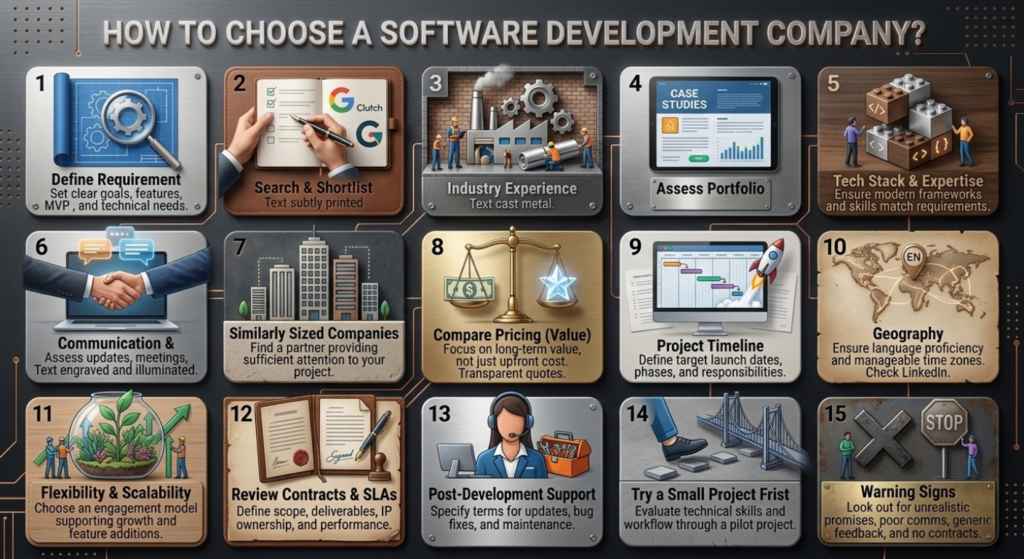
Here are 15 crucial aspects to keep in mind when choosing a software development company:
1. Define Requirement:
It is critical to establish your project requirement(s) and goal(s) before reaching out to a development company. Clearly define the problem you are trying to address/solve, who your target users will be, what your core features will be, and what your MVP will look like first, including an outline of both the technical (platforms, integrations, scalability, security, or compliance, etc.) and non-technical (budgeting, timelines, expectations for communication and post-launch support) requirements.
Most importantly, when selecting a company to partner with, ensure they have a clear understanding of your vision and that their goals are closely aligned with yours to prevent miscommunication and scope creep.
2. Search and Shortlist Potential Companies
Now that you have a clear understanding of your requirements, you should begin researching potential vendors that fit those requirements. Checking the top-rated vendors on Google would also provide information regarding their services, experience, prior work, and development methodology.
Additionally, you could use trusted review sites such as Clutch to compare reviews and client feedback between different vendors, along with case studies if they are available. You should apply filters such as location, budget range, industry vertical, and project size when creating your shortlist of potential partners.
3. Industry Experience and Specialization in Your Sector
Give priority to companies that stay updated with the latest technologies and industry innovations. It is essential to choose the one that has experience in your sector and understands the unique challenges, regulations, and end-user demands that vary across industries. A custom software development company with outstanding reviews in the market can offer support on potential issues and how to resolve them.
When reviewing a company, examine their portfolio, case studies, and past clients to see whether they have built similar products. An industry specialist can deliver faster due to their knowledge of what works in your sector and communicate more effectively to meet your requirements.
4. Assess Portfolio
First, investigate the firm’s past efforts. View their portfolio and look for case studies similar to yours or market experience. Test the apps and websites mentioned in their portfolio, if feasible. Also, check their reviews once you have a good understanding of what the company can do for you.
5. Tech Stack and Expertise
Before selecting a software development company, evaluate their technical expertise and the technologies they specialize in. Make sure their tech stack aligns with your project requirements, whether it’s web development, mobile apps, cloud solutions, AI, or enterprise software.
A strong development partner should be proficient in modern frameworks, programming languages, and tools while also following best practices for security, scalability, and performance. Choosing a company with the right technical foundation ensures your product is reliable, future-ready, and easier to scale as your business grows.

6. Communication and Cultural Fit
Clear communication is critical in software development, from defining requirements to sharing feedback. Even strong technical skills won’t matter if the team cannot communicate clearly and consistently. A reliable partner for outsourcing development tasks should understand your vision, provide transparent updates, and offer practical suggestions.
Use initial calls or meetings to assess how they respond, handle updates, manage meetings, and run feedback loops. Pay attention to their communication style via email and calls. Their team culture should align with your working environment to build trust, smooth collaboration, and a positive long-term partnership.
7. Rule of Similar-Sized Companies
Picking a business like yours offers some benefits. Most importantly, you want to be treated as a very significant customer. The business may be too large for them to provide you with sufficient attention.
They may not give you enough attention if the company is too big. And they may need more experience to work on such a scale if they are too small.
8. Compare Pricing Without Choosing the Cheapest Option
It’s easy to get caught up in comparing rates and searching for the cheapest software company. However, focusing only on upfront pricing can lead to costly consequences later. Instead of looking at the initial project cost alone, consider the long-term value and sustainability of the solution.
You can choose a pricing model that suits you best, hourly or project-based, but ensure the quote is transparent and all-inclusive, with no hidden charges. Clear cost expectations help you stay within budget and avoid unpleasant surprises.
Selecting a company solely based on low pricing may result in poor-quality code and significant technical debt, leading to higher maintenance costs and operational challenges in the future. Always evaluate the overall value, not just the price tag.
09. Define the Project Timeline and Expectations
It is important to clearly outline your expected timeline before starting the project. Decide on your target launch date, key milestones, and delivery phases to ensure everyone is aligned from the beginning.
Set realistic expectations around communication, reporting, feedback cycles, and approval processes. When both sides understand deadlines and responsibilities, it reduces delays, avoids misunderstandings, and keeps the project on track.
10. Geography
Communication is an essential part of any partnership; language should not be a barrier to effective communication. English is quickly becoming the primary language of global business, so you should find a team of highly creative problem solvers who have exceptional communication skills in English. Before outsourcing to a country with a drastically different culture, consider the communication challenges that may arise and the roadblocks it can cause.
To ensure you’re receiving the quality and security you need, do your homework and check the development team’s actual location through their LinkedIn profile, where their employees are located.
Read More: Why Software Projects Fail and How to Avoid This?

11. Flexibility and Scalability
When choosing a development partner, think beyond pricing and focus on how the engagement model supports your project’s growth. As your product evolves, requirements may change, new features may be added, and priorities may shift. A flexible approach, such as a time & materials model, allows you to adapt easily and scale development as needed while paying for actual progress.
For well-defined projects with clear documentation and stable requirements, a fixed-price model can work effectively. However, long-term success depends on selecting a model that not only fits your current budget but also supports expansion, feature enhancements, and future scalability as your business grows.
12. Review Contracts and Service Level Agreements
Before finalizing any partnership, carefully review the contract and Service Level Agreement (SLA). Make sure the scope of work, timelines, deliverables, pricing structure, and payment terms are clearly defined to avoid misunderstandings later.
Pay close attention to clauses related to intellectual property rights, data security, confidentiality, and termination terms. Clarify who owns the code and who is responsible for securing it, especially when sensitive data is involved. The SLA should also outline performance standards, response times, and support commitments. This is particularly important when working with offshore software companies, where legal clarity and communication standards must be well-documented. A clear and well-structured agreement protects both parties and builds a strong foundation for long-term collaboration.
13. Set the Terms of Post-Development Support
Post-development support is a critical part of any software project. Before signing the contract, clearly define what support the company will provide after the product is launched, including bug fixes, updates, feature enhancements, and maintenance.
Specify the duration of support, response times, and whether it’s included in the original contract or billed separately. Clarifying these terms upfront ensures your software remains stable, secure, and scalable and avoids surprises once the project goes live.
14. Try a Small Project First
Before committing to a large-scale engagement, consider starting with a small project or pilot. This allows you to evaluate the company’s technical skills, communication, workflow, and ability to meet deadlines.
A smaller project helps you identify potential challenges, test their processes, and assess scalability without taking on too much risk. Once you’re confident in their capabilities, you can confidently expand to larger, more complex projects.
15. Warning Signs
You can also eliminate many possibilities of problems later on by being aware of the following warning signs you might encounter in your search for a potential partner for your software efforts:
- Unrealistic timelines or cost promises
- Source Code Ownership
- Poor Communication
- Vague Descriptions of Portfolios/Services
- Generic Feedback/Recommendations
- No process for quality assurance and testing
- Avoid contracts and proper documentation
- Negative Client Reviews

Conclusion
The conclusion we can draw from this article is that choosing an appropriate software development company can have a huge impact on the outcome of your project. Important aspects to consider include:
- Assess the experience level of the software development company.
- Examine the company’s technology stack.
- Assess the method the software development company uses to develop software.
- Examine how the software development company communicates with its customers.
- Determine the level of personal connection you have with the company’s representative.
- Ensure that both you and the company’s representative have a mutual understanding of your business needs.
By considering these aspects, you can select a software development company that best meets your needs and expectations.
Avoid falling into the traps of selecting a partner that is substantially larger than your organization or choosing the lowest cost option. Collaborating with a software development company that understands your unique requirements and will work to support your success can help you bring your vision to fruition and achieve your business objectives.
Frequently Asked Questions on Software Development Company
1. How do I choose the Best Software Development Company?
Review the company’s portfolio, experience, client reviews, and technical expertise. Make sure they understand your business goals and follow a clear development process.
2. What Factors to consider before hiring a Software Development Company?
Key factors include experience, technology stack, development process, communication style, pricing model, security practices, and IP ownership.
3. Is it Better to Choose a Local or Offshore Software Development Company?
Both options work well. Local companies offer easier communication, while offshore companies are more cost-effective but may require time zone and cultural alignment.
4. How Important is the Tech Stack when selecting a Development Company?
The tech stack is very important. The company should specialize in the technologies required for your project rather than claiming expertise in everything.
5. Who Owns the Source Code after Development?
You should always ensure that the source code and intellectual property rights are transferred to you through a clear contract.