Software development traditionally follows a long and tedious process of moving from one step of the build to the next (there are steps for each phase). It works, however, during that time, you may lose out on opportunities or become frustrated over delayed launch timelines. With Agile software development, the process is not only much quicker because it allows you to work more collaboratively between teams, but also because it allows teams to incrementally improve throughout the lifecycle of building and testing your application.
Agility is a mindset that allows for faster, smarter decision-making by teams. The 16th Annual State of Agile report, published in 2023, found that 86 percent of businesses utilised Agile for developing software.

Key Takeaways
- Agile Software Development Life Cycle (SDLC) approach breaks the workflow into smaller, more flexible cycles called “sprints” to allow quick iteration in response to the changing needs of your customers.
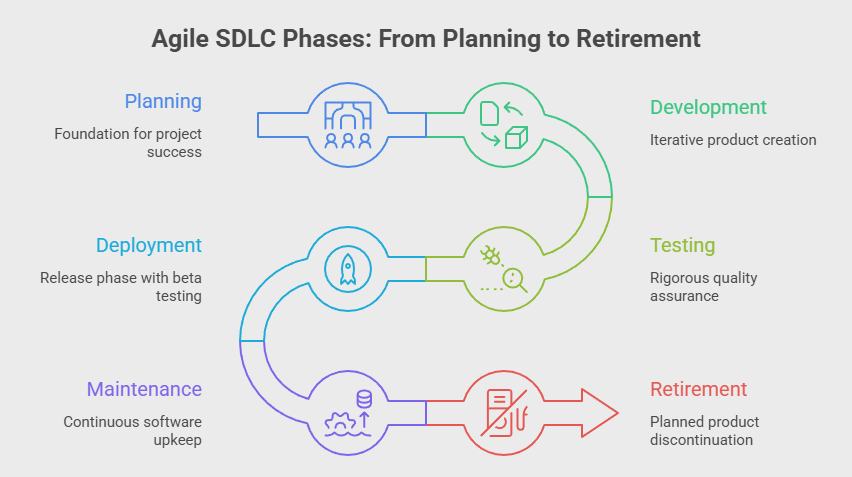
- The Agile methodology consists of six key phases: planning, development, testing, deployment, maintenance, and retirement, enabling fast feedback and continuous improvement.
- Compared to traditional approaches like Waterfall, Agile improves customer satisfaction, supports early issue detection, strengthens team collaboration, and enables more flexible product delivery.
- Popular frameworks, such as Scrum, Kanban, and SAFe, can be organised and customised using Monday Dev to streamline workflows.
- With Monday Dev’s AI tools, live dashboards, and automation, teams can collaborate better, accelerate delivery, and scale projects efficiently.
What Is the Agile Software Development Life Cycle (Sdlc)?
Agile SDLC is a flexible development process that prioritises user feedback, enabling teams to refine and improve the product continuously throughout the development cycle. Rather than doing everything at once, Agile allows users to work in short ‘sprints’, producing functional pieces of the product over time.
Agile SDLC teams perform regular reviews of their work to determine how well they are meeting customer requirements. Based upon their reviews of how well they are meeting customer expectations, Agile teams frequently adjust their approach to develop the best possible product to meet customer needs.
Each sprint lasts between two and four weeks, allowing for testing, faster delivery of updates, and lower risk. Throughout the project’s duration, all stakeholders remain involved and provide input to guide the team when making necessary changes.
To illustrate, the initial Sprint of a project may consist of building a simple graphical user interface. During subsequent Sprints, larger components of the system will be developed in incremental stages. The stakeholder can evaluate the product after each Sprint and advise the team on changes that may need to be made before proceeding to the next Sprint.
You Also Like: Benefits of IT Consulting for Businesses
Traditional Versus Agile SDLC
The Traditional SDLC, commonly known as the Waterfall model, works very differently from Agile. However, that doesn’t mean it doesn’t have its own advantages. Here’s a clearer comparison of both approaches.
| Category | Traditional SDLC (Waterfall) | Agile SDLC |
|---|---|---|
| Purpose (Similarity) | Both aim to build reliable, secure software within a defined timeline using structured processes that allow feedback and improvements. | Both aim to build reliable, secure software within a defined timeline using structured processes that allow feedback and improvements. |
| Rigidity / Flexibility | An iterative and incremental process with continuous updates, feedback loops, and frequent delivery of working software. | Highly flexible. Teams adapt plans as needs evolve. Planning, investigation, and testing occur continuously throughout the lifecycle. |
| Hierarchy | Operates through a defined top-down structure with clear chains of command and assigned responsibilities. | Encourages collaboration and treats all team members as equally important contributors, regardless of role. |
| Workflow Approach | Linear, sequential process where each phase must be completed before moving to the next. | Iterative and incremental process with continuous updates, feedback loops, and frequent delivery of working software. |
| Best Use Cases | Ideal for small to mid-sized projects with stable requirements, predictable workflows, and dedicated teams. | Ideal for large, dynamic, or complex projects, especially when multiple teams work remotely or requirements evolve frequently. |
Types of Agile Software Development Models

All Agile models follow the same core values, but each one has its own style, practices, and way of handling projects. Below are some of the most popular Agile SDLC models:
1. Crystal Agile Methodology
The Crystal Agile Methodology emphasises communication among all team members, adaptability, and focuses on the human factor in developing software. The best use of Crystal Agile is for projects that have very dynamic requirements and are likely to change a lot.
For example, if a startup is developing a new product that will most likely have its direction change based on the input from customers or other stakeholders during the development process, the startup would be able to use the Crystal Agile Methodology effectively because Crystal Agile allows for very rapid adjustments to the development process and places more importance on the people involved rather than following rigid processes to develop software.
2. Dynamic Systems Development Method (DSDM)
DSDM is designed for projects that have a moderate to high degree of uncertainty. DSDM has well-defined roles and responsibilities along with strong governance and structured processes to support fast delivery.
For example, large corporations or enterprises developing very complex internal technology solutions, such as HR management systems, would benefit from using DSDM because DSDM establishes clear roles and responsibilities, enables developers to work quickly, and controls the workflow in a well-organised manner.
3. Feature Driven Development (FDD)
FDD builds software based on creating a comprehensive list of defining features and developing them iteratively through distinct design-and-build cycles.
For example, FDD is ideal for larger-scale projects where the specifications or requirements are very detailed and specific, such as an e-commerce platform that needs to be regularly updated to meet customers’ evolving needs and requirements.
4. The Scrum:
The Scrum framework is a popular model for operating an Agile project and uses the iterative sprint method along with several distinct team roles to stay on track (i.e., Scrum Master and Product Owner). A natural fit for developing mobile applications, the Scrum framework provides teams with the ability to work iteratively and get continual feedback on their work so that they can make frequent refinements.
5. Extreme Programming (XP)
XP focuses on high-quality coding practices such as pair programming, continuous integration, and test-driven development. It supports teams that need to handle constant changes quickly.
Example: Commonly used in financial tech projects where regulations change fast and new customer needs must be addressed immediately.
6. Lean Development
Lean is a set of principles developed from the Lean manufacturing process that focuses on eliminating waste, increasing the tempo of delivering service, and maximising overall value. A specific use for Lean development is software as a service (SaaS) teams; these types of teams require the ability to provide continual updates to their products to remain competitive and meet customer expectations.
7. Unified Process (UP)
UP blends both iterative development and traditional Waterfall elements, offering a middle-ground approach. It suits teams that need structure along with flexibility.
An example of the application of the Unified Process would be the healthcare software industry; healthcare has to adhere to regulatory compliance, but still needs to produce software in small, incremental development cycles.
The 6 Phases of the Agile SDLC
Phase 1: Planning
The first phase creates a solid foundation for the entire project. The project team identifies the idea behind the project, identifies who the project is solving for, and what the team needs to do to get there. After defining the direction, the team develops a roadmap for the project, researching what has already been done by competitors and/or similar products to help avoid problems that could arise. While creating the roadmap, the team identifies the features that are to be completed within the scope of the project, calculates the amount of time/budget that will be needed to complete the feature set, and identifies any potential risks to be aware of.
Unlike in the Waterfall SDLC approach, the planning phase in Agile projects allows the team flexibility regarding how they proceed with the project as they continue to learn throughout the course of the project.
Phase 2: Development
This is the time when the team actually starts to develop the product. The team will develop the product in short durations of time, referred to as Sprints, which typically last 2-4 weeks in length (multiple Sprints can happen concurrently with different groups of Employees working together). Each Sprint will produce a small feature of the product (this can be functional or it may not be) that can continue to be improved until the project is complete. This method allows the project to be completed gradually, allowing for continual improvement of the product from feedback from users and/or stakeholders.
Since both Developers and Designers/Testers are working closely during the Development phases, they have the opportunity to make quick improvements to the current Sprints (if necessary) based on the feedback received. This process helps to mitigate risks associated with developing a complete product at one time while maintaining a continuous flow of progress in a steady manner.
Phase 3: Testing
The product undergoes rigorous Testing at the conclusion of every Sprint. Testing includes searching for Bugs; evaluating Performance, identifying flaws in the Design, and comparing the feature to user expectations. All findings will be documented, problems will be corrected, and an improved iteration will be built. Continuous Testing occurring before the launch is a significant benefit of Agile. By testing continuously throughout the development process, the Product receives real-time feedback from users before it is launched. Thus, it is less likely for Products developed under Agile to fail and more likely to contain a high degree of quality (Reliable Product Developments). Continuous Testing also allows for Products to continually evolve based on User feedback.
You May Also Like: What is Grey Box Testing?
Phase 4: Deployment
Deployment represents the Release phase. Ergo, instead of one, large Final Release, Agile encourages smaller, more frequent Deployments. Many Agile teams utilize a Beta Testing or Soft Launch approach, attempting to gauge user response as well as catch existing concerns based on actual usage. An important component of Deployment is integrating the various parts of your Product, including installing Servers, integrating Databases; and ensuring that everything works well in a live environment.
Phase 5: Maintenance
This phase ensures that the software remains reliable, functional, secure, and adaptable to changing user needs. The Maintenance phase is the final and ongoing stage of the Agile Software Development Life Cycle (SDLC). Unlike traditional SDLC models where maintenance begins only after the product is fully delivered, in Agile, maintenance is a continuous process that happens throughout the lifecycle after each release.
Phase 6: Retirement
At some point, every product will be discontinued because of either, lack of demand or replacement by new technology. Before discontinuing a product, the product team develops a detailed plan of how to discontinue/displace the product. As part of this process, product teams will notify customers of the discontinuing product and assist them with transitioning to updated products, migrating critical information from the old version to the new version, and transitioning from the old to the new version of the product. As a follow-up to the retirement of a product, the product team documents lessons learned to facilitate continual improvement in the way similar products will be produced in the future.

4 Key Benefits of the Agile Software Development Life Cycle (SDLC)
The Agile SDLC offers several major advantages for development teams. Agile teams report a 60% improvement in time-to-market and 52% better team productivity.
1. Deliver products that truly meet customer needs
The goal of the Agile SDLC is to build a product that genuinely matches what customers want, not just what you assume they want. Continuous feedback from users, test groups, and real-world interactions helps shape the product in the right direction. This ongoing input guides new features, improvements, and updates so the final product aligns with customer behaviour and expectations.
2. Adapt quickly to market shifts and new opportunities
Agile makes it easier to change direction when customer preferences or market trends suddenly shift. Maybe you start with one unique selling point, but during testing, you discover a much bigger opportunity waiting in another segment. Unlike traditional product management, Agile embraces change and allows teams to adjust their plans fast to take advantage of new possibilities.
3. Catch and resolve issues early in development
Traditional development moves through strict phases, which makes fixing problems difficult once you pass each stage. Agile works differently. It encourages constant review and feedback, helping the team spot bugs or weaknesses early on. This prevents small issues from growing into major setbacks and keeps the whole project safer and smoother.
4. Build stronger collaboration and shared ownership
Agile thrives on communication. Regular stand-ups, reviews, and discussions make sure everyone stays aligned and responsible for their part of the work. Traditional methods often rely on siloed handovers from one department to another, research hands off to design, design hands off to development, and so on. Agile replaces this with teamwork, shared responsibility, and continuous involvement from every member.
You Also Like: What is Business Analytics? A Complete Guide
How to Implement an Agile SDLC

Follow these steps to experience how the Agile SDLC works in real life.
1: Select the Right Agile Framework
The first step is choosing an Agile framework that helps your team organize and manage work effectively. Common frameworks include:
- SAFe: Scales Agile practices across large organizations with multiple teams and products.
- Scrum: Uses short sprints with defined roles (Product Owner, Scrum Master, Development Team) for continuous improvement.
- Kanban: Visual task management using a Kanban board, ideal for continuous workflow.
- Scrumban: A hybrid approach combining Scrum structure with Kanban flexibility.
2. Defining Goals
When teams move to Agile, they typically want to know why they are making that transition. By defining clear goals up front, teams know what the purpose is for making that transition, and this will unify the team around common goals. Common Goals for Agile are to:
- Concentrate on customer satisfaction and improving the user experience.
- Enhance collaboration between teams.
- Minimise project delivery lead times and improve upon scheduling bottlenecks.
3. Creating Implementation Plan
Moving to Agile requires some preparation; you cannot just wake up one day and be Agile. Teams that want to implement Agile should create an implementation plan that outlines the new meetings, process changes, and training sessions necessary for the successful transition. The implementation plan will provide the entire team with a common understanding and knowledge base from which the Agile SDLC will form.
4. Consider Security
Because of the speed of Agile, security must be part of the process for every step of the development cycle – without hindering development speed. Team members (developers) must be trained in writing secure code, and security requirements must be treated the same way that functional requirements are treated. Continuous automated security testing must occur in conjunction with Agile development, and automatic real-time results must be produced. An application security management (ASPM) tool such as Legit may be used to enable developers and security teams to have visibility into their entire software development environment and to understand which vulnerabilities warrant immediate attention.
5. Conduct Frequent Meetings
Good communication within an Agile environment is a major factor in making it successful, so its conversations must take place multiple times during the day. Daily Team Check-Ins will allow for communication between Teams. This daily meeting should consist of three main discussions: The Team’s Original Plan for the Day Before (YesterDay), the Team’s Better Plan for Today (Day) and of course, the Team’s Obstacle Alert.
6. Solicit Feedback
Upon receiving regular feedback following completed work in accordance with Agile principles, stakeholders should continually evaluate how effective various aspects of the process were and make necessary changes as a result of the information received through feedback. A major advantage of Agile’s software development life cycle (SDLC) over the traditional, waterfall approach is the ability to modify the way of working whenever necessary.
7. Establish Links Between KPIs and the Agile Transition
In order to evaluate if the Agile SDLC is truly working, the new way of working needs to be compared with knowable and defined metrics (KPIs). KPI Metrics may include indicators like Cycle Time, Frequency of Releases, and Customer Satisfaction Scores. The ability to measure these metrics will allow for more thorough evaluations of how successful the transition to Agile has been and continues to be.

Final Thoughts on Agile Software Development
Agile Software Development Life Cycle will not change how software is built, but allows teams to build better, faster, and more collaboratively and to create increased value from day one of the development process. The Agile SDLC allows for development flexibility, focus on customers, and continual improvement because teams build the software in small increments through short sprints. Teams work to build the software through sprints so that they can test their ideas quickly, receive feedback, and make changes at virtually any time during the project instead of waiting months for the results of the previous sprint.
Agile SDLC models, including Scrum, Kanban, Scrumban, and SAFe, allow organisations to choose the Agile SDLC model that fits their organisation’s size and workflow. However, regardless of the Agile SDLC model that is used, organisations’ goal is to provide customers with the highest quality products, minimise risk, and enhance teamwork.
The six Agile SDLC phases, from the planning phase to the retirement phase, provide the organization with structure and will still allow creativity and flexibility. With a foundation of solid communication, clear KPIs, and sound security practices, Agile enables organizations to quickly deliver high-quality software.
Automation, real-time dashboards, and customizable boards, such as Monday Dev, make the Agile SDLC process even more manageable. Ultimately, Agile is learning from and improving upon each sprint to develop products of real value to the customer.
Ready to take your software development to the next level? Contact Dependibot Solutions today and discover how Agile can accelerate your projects, improve collaboration, and deliver better results.
FAQs
1. What is the difference between “Agile” and “SDLC”? Are they the same?
- “SDLC” refers broadly to the process of building software, from planning to delivery and maintenance.
- “Agile” is one approach (methodology) to follow that process: an iterative, flexible SDLC style emphasising short cycles, frequent feedback, and adaptability.
- So Agile is a type of SDLC (among others), not a separate idea.
2. Why would a team choose Agile over a traditional model like Waterfall?
- Agile allows for changes even late in development, so it handles evolving requirements or market shifts better.
- It enables frequent deliveries (increments), which means faster time-to-market and early feedback.
- It fosters continuous collaboration among stakeholders, developers, and customers, improving product alignment with user needs.
3. Can Agile work for any size or type of project?
- Agile works best for projects where requirements can change over time, or where early feedback and flexibility matter.
- For projects with very stable requirements or when regulatory/compliance demands heavy documentation, traditional SDLC or hybrid approaches may still be appropriate.
4. What are the common drawbacks or challenges of using Agile?
- Because Agile is flexible and iterative, it can be harder to predict the final timeline, scope, or cost upfront.
- Continuous stakeholder involvement and frequent changes can lead to “scope creep” if not managed carefully.
- Teams need discipline, good communication, and capable cross-functional members; not every team thrives under Agile.
5. How does Agile ensure software quality and reduce risks compared to traditional methods?
- In Agile, testing and feedback happen throughout development (not just at the end). This allows early detection and resolution of bugs or design flaws.
- By delivering working increments often, teams can validate assumptions early, gather real user feedback, and pivot if needed, reducing wasted effort and risk.