
The firts Website orginated in 1991 and now website have become an integral part of businesses to have an online presence. Whereas, website development process is creating a website that appears to be a complicated task that requires many different steps and phases before ultimately launching your website.
Here’s a quick view of the website development lifecycle.
- Phase 1. Planning
- Phase 2. Website Design
- Phase 3. Content
- Phase 4. Development (Coding)
- Phase 5. Quality Testing
- Phase 6. Launch and Support
In this comprehensive guide, we will walk you through every phase of the website construction process (planning, building, and launching) so that you are better equipped when creating your first website or upgrading an existing website; all the steps discussed below should be incorporated into your overall success in web development.
Table of Contents
What is Website Development?
Website development is the process of creating an online presence for businesses, brands, or individuals through websites and applications.
At its core, web development is a foundation that brings together multiple aspects: designing the website, building its structure, creating content, and integrating functionality using backend technologies. The main goal is to create a website that is both engaging for users and effective in achieving business objectives.
Website development may seem complex, but it follows a structured process which inlcudes planning, building, and launching, which ensures your site works smoothly, looks appealing, and meets your audience’s needs.
You May Also Like: Why Do Companies Outsource Software Development?
3 Types of Website Development
Website development mainly falls into three types: front-end, back-end, and full-stack development. Each plays a different role in building a website.
Front-End Development
Front-end development focuses on what users see and interact with on a website. This includes the layout, colors, fonts, images, buttons, and navigation. A front-end developer is responsible for how a website looks and feels, making sure it’s easy and enjoyable to use.
Back-End Development
Back-end development works behind the scenes. It focuses on how the website functions rather than how it looks. This includes handling data, user logins, servers, and databases. Back-end developers make sure everything runs smoothly when users submit information or perform actions on the site.
Full-Stack Development
Full-stack developers handle both front-end and back-end work. They can manage the entire website development process, from design to functionality. Because one person can cover multiple roles, many businesses prefer full-stack developers, though they are in high demand.
Read More: How To Outsource Web Development Like a Pro

Website Development Process
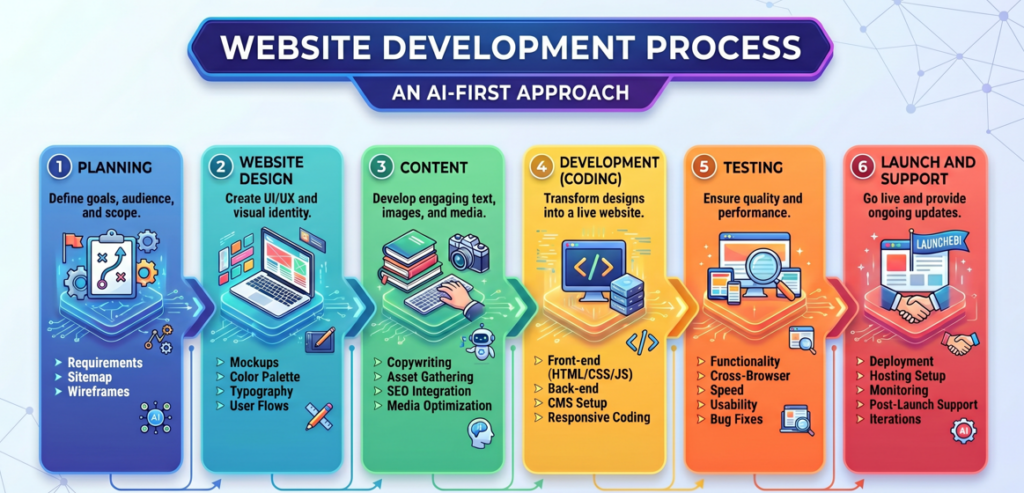
Website development process follows several interconnected phases. With this process, each phase involves essential decision-making, from defining the website’s purpose to launching and maintaining the final product. These steps ensure the website is functional, user-focused, and aligned with business goals.
Phase 1. Planning
The planning and preparation phase sets the foundation for the entire website development process. This stage focuses on defining the website’s purpose, understanding the audience, and gathering all the information needed before moving into the next phase. Careful planning helps avoid confusion later and ensures a smooth transition between each stage of the project.
Choosing the right web development technologies, frameworks, libraries, and development tools is a strategic investment for web developers, providing them with a pathway to deliver their projects more easily and efficiently.
Key Activities in the Planning Phase:
- Define the website niche and goals: Identify the website’s niche and clarify its main objectives, such as building brand awareness, generating leads, or providing information to users.
- Identify the target audience: Understand who the website is for by analyzing user needs, preferences, and behavior. This helps shape the design, content, and functionality of the website.
- Develop a website strategy: Create a clear strategy that outlines how the website will meet business goals while delivering value to users. This includes planning content direction, features, and overall user experience.
- Set budget and timeframes: Establish budget restrictions and realistic timelines to ensure the project stays on track and within scope.
- Plan website structure and requirements: Outline the website hierarchy, required pages, and core functionality to ensure logical navigation and smooth user flow.
- Selecting appropriate frameworks: Evaluate and choose suitable web frameworks such as JavaScript and PHP frameworks to ensure scalability, security, and performance.
- Optimizing development workflow: Ensure that all selected technologies align with project goals without compromising quality or efficiency.
Read More: What is a Tech Stack?
Phase 2. Website Design
The website design phase marks a critical shift in the web development process, where creative and functional elements merge into a cohesive design concept. Using the approved wireframes from the planning stage, UI designers collaborate with clients to transform ideas into visually engaging and user-focused designs.
When considering the target audience, UI designers create a strong foundation for an effective website design, ensuring the experience is immersive, meaningful, and aligned with the website’s purpose. Website design goes beyond visual appeal and includes branding, usability, and emotional impact through color selection and layout choices.
Key Activities in the Design Phase:
- Define visual branding: Establish color schemes, typography, and visual elements that reflect the brand identity and purpose.
- Develop wireframes and mockups: Create low-fidelity layouts and high-fidelity design concepts based on approved structures.
- Design core website pages: Develop homepage layouts, internal page templates, and visual assets.
- Refine user experience (UX): Ensure intuitive navigation and smooth interaction across all sections of the website.
- Select design tools and applications: Use industry-leading tools such as Figma, Adobe Illustrator, and Adobe Photoshop to create high-quality designs.

Phase 3. Content
Content is the next step in the web development process. Ensure that content aligns with your target audience and business strategy. High quality content under the Google SEO guidelines help websites rank better on Google SERPs, plus it enhances user engagmenet to drive more conversions. Content is not limited to text but it also includes i.e. images, videos and other media assets.
At the heart of the website is content. Content drives people to your website and helps build your brand identity, which in turn means that it makes people want to be associated with you or it makes people want to run away from you. The level of content will ultimately determine your conversion rates as well. Strong website content not only answers user questions clearly but also supports SEO and enables personalization. Effective personalization can reduce acquisition costs by up to 50%, increase revenue by 5–15%, and improve marketing ROI by 10–30%.
Remember, your unique style as a coach, or ‘brand’, clearly defines you to your clients and audience, and that will support your growth into a successful business by helping to create a unique connection with your clients. Use these valuable points to create and view your website as the story of your business and who you are.
Key Activities in the Planning Phase:
- Defining primary website chapters: Identify core sections such as Home, About, Products/Services, Blogs, and Contact Us.
- Brainstorming content for each chapter: Thoughtfully plan what each section will include, aligning it with your business strategy.
- Assigning target keywords: Select one main keyword for each chapter to support SEO and user engagement.
- Determining content style and tone: Reflect your unique brand or coaching style to create a consistent and authentic voice.
- Planning additional content components: Include supplementary elements like course material, pricing, instructions, and other relevant information.
Phase 4. Development
Once the design and content of the website are finalized. Development of the website begins and all the design and content assets are delivered to the development team for deployment. A fully functional website is created that involves front-end and back-end development.
The dynamic and interactive relationship between the backend and frontend of a website is coordinated by team of developer, designers and seo experts. The way store logic is integrated into the website’s data storage provides a cohesive and seamless experience for users.
Key Activities in the Development Phase:
- Developing web markup and code: Create and structure HTML and other programming code to build the website’s core framework and functionality.
- Utilizing efficient development tools: Adopt modern programming languages, advanced code environments, and deployment tools to streamline workflow.
- Preparing technical specifications: Produce detailed technological documentation outlining backend and frontend requirements.
- Integrating frontend and backend systems: Ensure smooth communication between user interfaces and server-side operations.
- Implementing backend logic and data storage: Build a strong foundation that manages database interactions and business logic efficiently.
- Enhancing interactivity and personalization: Design dynamic features and tailored user experiences to improve engagement and customer satisfaction.
- Implementing essential plugins: Integrate only necessary and reliable plugins to enhance functionality while maintaining performance and stability.
- SEO optimization: SEO expert implements search engine optimization (SEO) best practices to improve your website’s visibility and ranking in search results.
Phase 5. Quality Testing and Assurance
Quality assurance is the next critical step in web development before the website goes live. Before a website is first put on a server after being developed, a carefully detailed step-by-step checklist for testing the website is created in order to test for any potential problems. A separate QA team then carries out comprehensive testing of the website’s functions, usability, compatibility, speed, and ultimately, all aspects of the website being developed.
Once a website has been officially developed, the website needs to operate smoothly without any errors or glitches. To ensure this is accomplished, QA team conducts extensive testing of each script in order to confirm everything loads and works as intended across all devices and browsers. This phase of the project is the foundation for determining whether or not a website can be considered “market-ready” before going live, and it identifies potential areas for future improvements and upgrades.
Finally, the development team fine-tunes the website specifically for the use of that site. The fine-tuning stage includes optimizing all aspects and features of the website through various optimizations, including implementing additional plugins, on-page SEO optimization, and improving the speed of loading pages.
Once the QA testing team has given their stamp of approval and confirmed that everything is ready for launch, the final step is for the website to be launched on the server and made available to the public.
Key Activities in the Testing and Launch Phase:
- Preparing a detailed testing checklist: Develop a structured step-by-step plan to identify potential issues before deployment.
- Conducting quality assurance (QA) testing: Perform comprehensive testing of functionality, usability, compatibility, performance, and responsiveness across devices and browsers.
- Executing script and performance testing: Verify that all scripts, features, and integrations load and function correctly without errors.
- Optimizing website performance: Improve speed, implement necessary plugins, and apply on-page SEO techniques to enhance overall efficiency.
- Final review and deployment: Obtain QA approval and launch the website on the live server for public access.
Phase 6. Launch & Support
The launch phase marks a major milestone in the website development process. It is the result of careful planning, thoughtful design, content creation, and thorough testing coming together to make the website live. Launching a website is not just about uploading files to a server; it is a strategic process that ensures all technologies, tools, and features are seamlessly integrated and optimized across different devices and browsers.
This stage represents the official unveiling of the website, designed to attract, engage, and deliver a smooth experience to the target audience. Key performance metrics such as loading speed, responsive design, and flawless functionality are closely monitored to ensure the website performs as expected.
Once the website is live, the focus shifts to post-launch support and maintenance. This phase is essential for long-term success and ongoing optimization. Continuous monitoring through analytics, user feedback, and performance tracking allows for timely updates, improvements, and fixes. Immediate modifications may be made to enhance usability, improve content, and meet evolving audience expectations.
Although the launch signals the completion of development, post-launch support ensures the website continues to grow, adapt, and perform effectively in an ever-changing digital transformation environment.
Key Activities in the Launch & Post-Launch Phase:
- Website deployment and go-live checks: Ensure all files, features, and integrations are properly uploaded and functioning before public release.
- Performance and responsiveness monitoring: Track site speed, device compatibility, and overall functionality to ensure a smooth user experience.
- Analytics setup and tracking: Implement analytics tools to measure traffic, engagement, and other performance metrics.
- Collecting user feedback: Gather insights from users to identify areas for improvement.
- Ongoing updates and optimization: Continuously improve content, fix issues, and adapt the website to evolving user needs and technological changes.

9 Tips for Website Development
Here are some practical, human-friendly tips to help you build a better website, inspired by expert insights on effective web design and development:
1. Keep Your Design Consistent
Use the same colors, fonts, spacing, and styles across your site so visitors instantly recognize your brand and feel comfortable navigating every page.
2. Make It Simple
Avoid clutter. A clean, focused layout makes it easier for users to find what they need and take action, like clicking a button or filling a form.
3. Prioritize Mobile Users
More than half of all web traffic comes from phones and tablets. Ensure your site looks great and works smoothly on every screen size.
4. Create Clear Navigation
Organize your menu and links so users always know where they are and where to go next. Simple, intuitive menus reduce confusion and frustration.
5. Use Colors and Contrast Smartly
Good color contrast makes text easier to read, and important buttons stand out. Choose colors that match your brand and help communicate your message.
6. Focus on Readability
Use legible fonts and clear text sizes so people can easily read your content. Avoid overly fancy fonts that make reading hard.
7. Highlight Call-to-Actions (CTAs)
Make your main buttons (like “Buy Now” or “Contact Us”) stand out with size, color, and placement so users know exactly what to do next.
8. Use White Space Effectively
Giving space around text and images helps users focus and prevents important parts of your site from looking crowded.
9. Test and Improve
After building your site, test it on different devices and browsers. Fix any issues and continue improving based on real user behavior.
Read More: What is Software Development? Explained the Easy Way
Conclusion
All of the steps in website building are important, and by understanding what these steps are and how to maximize your resources, you can create a positive impact for your organization. Everyone will find a benefit from using our all-inclusive seven-step guide.
At Dependibot Solutions, we have an awesome team of skilled front-end and back-end web development professionals available to support you and your web development initiatives. If you are interested in creating a successful website, you can access our team of web development experts from all around the world to help you achieve visibility and success through high rankings in search engines.
Frequently Asked Questions on Website Development Process
1. What is the website development process?
The website development process is a series of steps involved in creating a website, including planning, designing, building, testing, launching, and maintaining it to ensure a functional, engaging, and user-friendly online presence.
2. What are the 7 stages of website development?
The seven stages of a successful web development project are as follows.
- Strategic blueprinting: Align digital aspirations with tangible business logic.
- Web design process: Unite aesthetics into one product of user-centric functionality.
- Code: Develop a website as a robust foundation for performance and scalability.
- Content writing craft: Narrate stories that resonate with your target audience after the site launch.
- Rigorous testing grounds: Ensure flawlessness through meticulous examination of the business website.
- Launch moment: Unveil your development project to the world.
- Fine-tuning: Optimize for sustained digital success.
3. What are the main types of web development roles?
Web development roles generally fall into three categories:
- Front-end developers: Focus on how the website looks and behaves in the browser.
- Back-end developers: Handle databases, server-side logic, and functionality behind the scenes.
- Full-stack developers: Work on both front-end and back-end aspects.
4. How long does it take to develop a website?
The time to develop a website totally depends on the complexity, features, and design requirements of the web. However, simple websites can take a few weeks, while complex sites with custom functionality and features may take a few months to complete.
5. What can web developers actually build?
Developers can create personal websites, company homepages, e-commerce sites, web apps, and more. As skills grow, they can move into API development, automation tools, or AI-powered applications.