Quality assurance ensures products and services consistently meet defined standards, delivering reliability, performance, and customer satisfaction.
Quality Assurance (QA) outsourcing is the practice of hiring an outside team to handle some or all of your software testing. Lots of companies do this because it can save money, speed things up, and get you access to testers who are really good but hard to find on your own.
This guide will cover what QA outsourcing is, how it works, different ways to do it, when it makes sense, the pros and cons, how to pick the right team, and some tips and trends.

Key Takeaways:
- Outsourcing QA helps to lower expenses and improve the quality of goods
- Selecting the right partner is essential for sustained success.
- It lets businesses concentrate on their main activities and grow more quickly.
What Is QA Outsourcing, and How It Operates

QA outsourcing is the process whereby you give an outside vendor or team control of QA or testing duties for your application. This might cover mobile and usability testing as well as performance testing, security and compliance testing, and manual testing. Automation testing is another possibility.
Usually, the procedure starts with identifying your QA objectives, the kind of testing you need, the standards to be met, timelines, and quality objectives. You next select a QA partner based on expense, resources, and knowledge. You then establish collaboration tools and communication channels (for example, Slack, Jira, Trello) so that the contracted staff becomes an integrated component of your process. The companion carries out test cycles, documents defects and outcomes, and then you collaborate on fix/verify loops. Over time, you modify your testing methods and guarantee ongoing improvement.
Compared to in-house QA, outsourced QA offers key differences: cost (often lower due to external resource models), scalability (you can ramp up or down more easily) and flexibility (you can bring in specialist skills for a one-off need rather than hire full-time). However, you also trade some control and may face operational coordination challenges.
Software Outsourcing Models
There are several models that QA outsourcing companies typically use:
1. Traditional Testing Services
This model includes manual and regression testing of all functions; the vendor will take responsibility for everything from test planning to execution. This model is ideal for companies that want to completely outsource testing along the full testing continuum without having to develop an internal QA infrastructure. The traditional testing team is focused on manual testing of the application as it pertains to functionality, user interface, and usability, to ensure the product meets requirements on multiple devices and platforms.
Although manual testing is comparatively slower than automation, it provides more comprehensive insights at the user level and can more easily uncover edge-case bugs. The traditional testing model is typically used in industries where the product has compliance or documentation, or where assessments are subjective, like in healthcare, finance, and enterprise software; this model also generally allows for scalability of the testing cycles.
2. Specialist Testing
Specialist QA outsourcing means you are getting domain-specific or complex testing work like automation, security, performance, compliance, or mobile testing etc. With specialist testing, you are not outsourcing the entire QA function, but rather hiring expertise that can help provide targeted support. For example, an automation specialist may build test frameworks to enable you to recoup regression testing cycles, while security testers conduct penetration and vulnerability assessments to keep your information safe.
This model is best utilised when your on-site QA team already handles functional testing but lacks niche expertise. The specialist testing model factor provides quality, risk reduction, and access to the latest tools and methodologies without having to find or hire full-time specialists internally..
3. Onshore Model
Outsourcing QA (quality assurance) models involve working with vendors in distant countries, typically with very low per-transaction fees. Three common outsourcing options are in India, the Philippines, Vietnam, and Eastern European countries. An outsourced team can provide 24/7 coverage; the offshore options allow for testing coverage to become sustainable quickly, ultimately expediting the QA process. Offshore models are attractive because they are low-cost, provide access to a wealth of cold QA knowledge workers, and allow for 24×7 work hours. Because those benefits can compress release cycles, outsourcing QA is often appealing.
However, outsourcing a project does involve managing challenges, circumstances that are related to time zone, communication, and culture between the organization and the offshore vendor. Any company must integrate its project governance procedures and collaboration tools to manage all these issues. Organizations that have a high volume and regularly execute QA processes, such as enterprise product testing, usually turn to offshore suppliers both for efficiency and financial benefits.
4. Nearshore Model
The nearshore model allows for the same collaboration as onshore, except that the QA vendor teams will be located in neighbouring or nearby countries. For example, you will have companies in the U.S. working with vendor teams in Latin America or Western European companies working with vendor teams in Eastern Europe. This offers a balance between the cost reduction of offshoring QA and the communication likelihood of onshore QA. There is a time zone overlap, which allows for real-time collaboration as well as geographic proximity for possible occasional on-site visits.
Nearshore QA vendor teams frequently share the same business culture and level of English proficiency, reducing friction with collaboration. The nearshore QA model is also an attractive approach for agile development environments where the speed of coordination and feedback is essential to the success of iterated development. Companies often find nearshore QA ideal for long-term partnerships and scaling regional projects.
5. Offshore Model
Outsourcing QA (quality assurance) models involve working with vendors in distant countries, typically with very low per-transaction fees. Three common outsourcing options are in India, the Philippines, Vietnam, and Eastern European countries. An outsourced team can provide 24/7 coverage; the offshore options allow for testing coverage to become sustainable quickly, ultimately expediting the QA process. Offshore models are attractive because they are low-cost, provide access to a wealth of cold QA knowledge workers, and allow for 24×7 work hours. Because those benefits can compress release cycles, outsourcing QA is often appealing.
However, outsourcing a project does involve managing challenges, circumstances that are related to time zone, communication, and culture between the organization and the offshore vendor. Any company must integrate its project governance procedures and collaboration tools to manage all these issues. Organizations that have a high volume and regularly execute QA processes, such as enterprise product testing, usually turn to offshore suppliers both for efficiency and financial benefits.
6. Managed QA Services
The outsourcing partner takes complete accountability for your whole QA operation, from strategy and planning to implementation and reporting, under a managed services model. Running individuals, systems, and technology, the vendor works as though for a committed QA department. Companies trying to outsource QA administration but retain quality supervision by means of defined KPIs and SLAs fit this model most well.
Advantages include consistent quality upgrades, clearly specified governance, and predictable expenses. To offer visibility, managed QA providers frequently combine automation, continuous testing, and analytical dashboards. It is a long-term, strategic alliance best suited for companies that emphasise scalability and innovation.
7. Staff Augmentation
Staff augmentation allows your internal QA staff to receive assistance from external professionals for a specified duration or specific project. In contrast to outsourcing a complete QA effort, you are leveraging credentialed testers, automation experts, or subject matter experts to assist your existing team.
This model provides the most operational control and flexibility, as you supervise the team in a direct capacity while the vendor augments your team with recruitment, onboarding, and contracts. It is best suited for interim initiatives, peak workload events, or transitional capabilities in areas like automation scripting or performance testing.
This model provides the biggest ramp-up advantage, while also not burdening the organization with the administrative functions required from full outsourcing or permanent employees. Your internal goals, budget, competencies, timelines, and risk appetite will define which model you pursue.
You may also like: Quality Assurance vs. Quality Control
When to Outsource Quality Assurance
When your team has to provide faster, manage challenging testing, or momentarily increase capacity, outsourcing quality assurance can be a wise strategic decision. It’s not a one-size-fits-all solution; in some situations where outside knowledge supplements your internal capabilities, it offers the greatest value.
For several businesses, outsourcing is also an affordable option. For example, while the average yearly pay for a QA engineer in Chile is about $76,270, in the United States it is approximately $88,230. These disparities emphasise why companies frequently search overseas for qualified, cost-effective testing talent.
The following are some of the most common circumstances in which QA outsourcing fits best for contemporary software teams:
1. Quick release cycles and strict deadlines
Building and training an internal QA staff can take weeks or even months, time you do not have, when your project has a rigid launch date. Outsourcing lets you get going nearly instantly.
Experienced QA suppliers may build a ready-to-go testing crew, fit your procedures, and start running test scenarios in days. Their existing tools, frameworks, and procedures shorten your setup phase and guarantee your release stays on time. This strategy is especially appropriate for product launches or startups when time is of the essence.
2. Gaps in Internal Experience
Your in-house testers occasionally show expertise in particular fields like automation, API testing, or security assessment and compliance testing, but lack experience in other areas. Outsourcing swiftly covers those gaps instead of stopping development to train your staff or employ permanent employees.
Whether it be Selenium and Appium for automation or OWASP and Burp Suite for security, external QA specialists provide the appropriate tools, frameworks, and domain knowledge. This implies your product gains from top-tier testing techniques without interfering with current development or overloading your core team.
3. Resource-intensive long-term projects
Maintaining a full-time internal QA department for long-lasting or extensive projects can be costly. Employing, supervising, and keeping testers over long cycles quickly adds up.
Here, financial logic dictates outsourcing; external suppliers usually offer lower rates while upholding uniform quality. Without depleting your internal budget, they can help with ongoing testing, regression cycles, and product upgrades. Many businesses depend on long-term QA relationships to strike a balance between cost control and consistent quality assurance throughout the lifespan of the product.
4. Short-Term or Specialised Projects
Creating a whole internal QA team makes little sense if your project is small, temporary, or centred on a certain testing type (e.g., black box testing or white box testing). Outsourcing offers you flexibility; you may get testers for a few weeks or months, stop the project when work declines, and re-engage as needed.
With this “on-demand QA” method, startups and small companies can uphold quality without permanent obligations or set overhead expenses. It fits project-based work wonderfully and is fast and inexpensive.
5. Freeing Your Team to Focus on Core Business
Building software is about strategy, design, customer experience, and expansion as much as it is testing. Productivity and concentration can suffer when your managers and developers have to balance QA duties on top of all else.
Your in-house team can focus on their strongest ability, developing new capabilities, enhancing user experience, or fueling innovation, while a specialised QA team guarantees the stability and reliability of the product by outsourcing QA. This split of labour increases efficiency and produces a more balanced, effective flow of work.
You may also like: What is Grey Box Testing?
Benefits of Outsourcing Quality Assurance

While outsourcing QA has several advantages, from specialised skills to speedier releases, it also presents some difficulties that companies should prepare for. One side will be investigated more thoroughly next.
1. Global Talent Accessibility and Advanced Testing Techniques
When outsourcing, you are utilizing a worldwide repository of qualified QA specialists who are already working with modern testing tools and frameworks. You gain preassembled knowledge in things like automation, performance, and security testing, rather than starting from scratch. Many vendors also maintain dedicated teams that have been trained on modern practices and utilise advanced tools, including Selenium, JMeter, and Appium. This mixture of talent and technology ensures better test coverage and fewer defects making their way into production.
2. When internal resources are scarce, enlist QA professionals.
If you don’t have enough in-house staff or they are otherwise engaged, and staff augmentation is needed, outsourcing fills the void immediately. You do not have to spend many months finding or teaching a new test author or automation engineer. Experienced QA professionals begin working on your project immediately upon arrival, with capabilities that your team may lack, from test automation to compliance testing. This approach allows an organization to maintain efficiency during crunch periods or growth scenarios without overextending internal personnel or sacrificing the quality of the product.
3. Cost savings and elastic resource scaling
Creating a permanent quality assurance staff can be expensive, especially for smaller businesses. Fixed costs are substituted with flexible, pay-as-you-go agreements when outsourced. You may scale your QA resources up during peak development cycles and down after significant releases are finished. This not only improves your budget but also helps to make expenses consistent.
4. Faster time to market with parallel testing
You release goods faster when QA parallels development. Outsourced teams can evaluate your in-house developers’ features, therefore reducing the whole cycle. Testing and bug fixing take place constantly, particularly when working with offshore collaborators, with around-the-clock coverage. This results in fewer bottlenecks, quicker releases, and faster feedback loops. Outsourcing QA is a major accelerator for continual delivery for businesses under pressure to constantly update.
5. Objective and Impartial Quality Assurance
Utilising an external QA team provides an impartial and fresh approach. An external QA team is not hands-on involved in the software development, so they are likely to identify issues that might go unnoticed by your internal team because they are used to what they have done and have developed assumptions about the software.
Having the QA function independent from the Development function will lead to higher-quality testing, which contributes to a more reliable product. Moreover, many companies find that outsourced QA partners normally concentrate on metrics, such as defect density, test coverage, and ultimate release quality, instead of internal politics or deadlines.
6. Enables Developers to Focus on What They Do Best – Development
While testing is essential to every product iteration and is very much intertwined with development, testing requires a different set of skills and mindset, meaning the developer has to shift. Assigning this role and paying people to test allows your developers to spend 100% of their time coding, creating, and improving UX.
This split allows developers to push new updates to their respective DevOps environment confidently without missing a beat to write test cases and regression cycles. Handing off the testing component will improve workflow efficiency overall and accelerate the intervals between releases.

3 Key Challenges of Outsourcing Quality Assurance
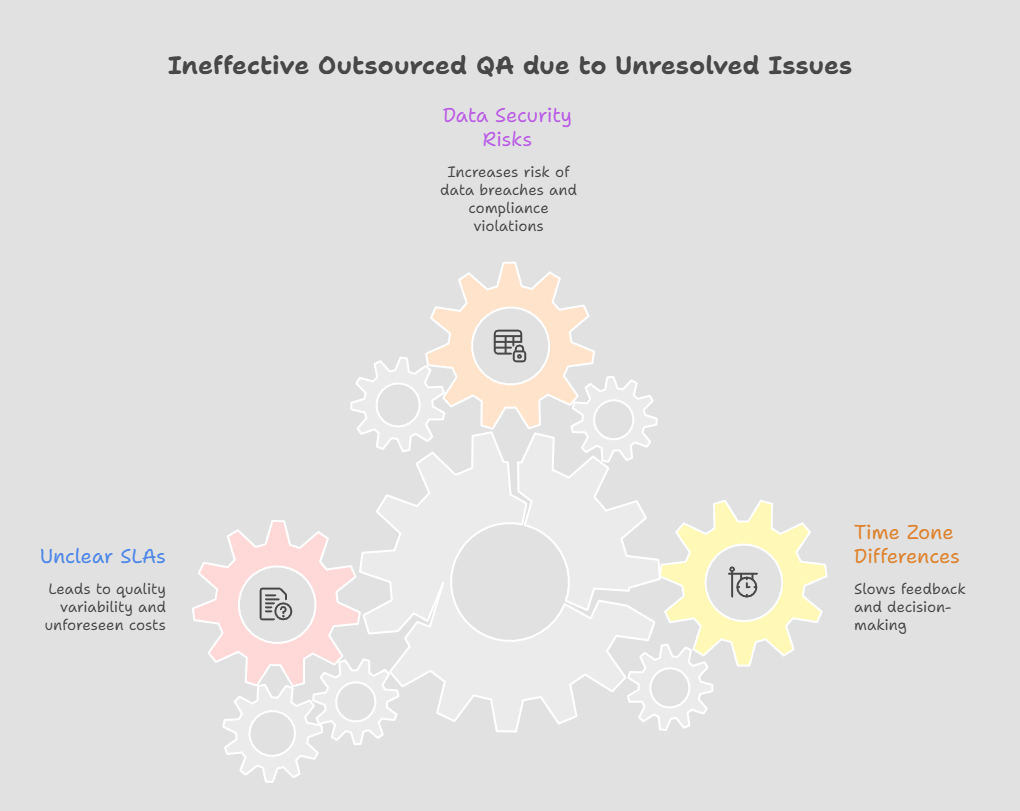
Outsourcing Quality Assurance has many benefits; however, many issues arise that need attention and resolution before either party moves forward.
1. Communication Issues Related to Time Zones
Offshore QA teams will generally work in different time zones, linguistic styles, and cultural approaches than the North American team, which will slow down both real-time feedback and overall project decision-making. If communication is unclear (instructions) and responses are slow, this will negatively affect testing productivity/efficacy.
Solution: Create a working schedule that allows for overlaps within both teams, establish explicit communication procedures, and utilize collaborative software (for example, Slack, Jira, Confluence) to help both teams sync on what is expected of them.
2. Security Issues Surrounding Data Privacy & Protection
If an outsourced QA team accesses sensitive data such as a company’s source code, as well as information related to users of its products/services or the business itself, without having the necessary controls in place, it will ultimately place the outsourcing company at risk of breach and/or violating multiple compliance requirements.
Solution: Partner only with vendors who comply with international security certifications/standards (for example, ISO 27001, GDPR) and use secure data transfer methods when sharing sensitive information; in addition, NDAs should be enforced to further protect confidential information from unauthorized releases.
3. Lack of Clear SLAs Creates Quality Variability.
There may be instances where items finish on time but contain serious problems if there are no clearly established quality benchmarks and responsibilities. Such issues can create unforeseen costs to your company, along with negative customer experiences and a damaged reputation.
Solution: Create a detailed Service Level Agreement (SLA) that includes your quality benchmarks, how to report issues, the definition of defect severity, and who is accountable for meeting these expectations for all parties involved.
How to Pick the Right Software QA Outsourcing Partner
Selecting a quality partner is one of the most important decisions. Some steps you should take:
- Start with a pilot project before a full engagement. A smaller initial contract allows you to assess the partner’s performance, cultural alignment, and workflow fit without major risk.
- Evaluate experience and industry expertise. Does the vendor have a track record in your domain (fintech, mobile apps, enterprise, etc.)?
- Review case studies, testimonials, and client references. Ask for metrics: defect detection rate, time to test cycle, and client satisfaction.
- Check for certifications or compliance standards (e.g., ISO 9001, ISO 27001 for security, GDPR compliance) that show maturity.
- Assess communication, transparency, and reporting methods, how often you’ll get progress reports, dashboards, and what tools they use.
- Confirm the use of modern testing tools and automation frameworks; vendors that still rely 100% on manual testing may fall short in speed or coverage.
- Discuss pricing models and scalability options. Is the vendor able to scale up test teams quickly? Are there hidden costs?
5 Best Practices for Successful QA Outsourcing
To make your outsourcing engagement successful, follow these best practices:
- Set clear KPIs and deliverables from the start. Define what “good” looks like: test coverage, defect leakage rate, cost per test cycle, time to test.
- Maintain consistent communication and progress reviews. Regular stand-ups, weekly reports, and dashboards help keep alignment.
- Use collaborative tools (Jira, Trello, Slack, Confluence) so your internal and external teams work off the same information and backlog.
- Ensure transparent test documentation and reporting. The vendor should deliver clear test plans, test cases, defect logs, metrics, and root cause analyses.
- Build a long-term partnership mindset, not just a vendor relationship. Treat the outsourcing team as part of your project rather than a distant contractor, share business context, product vision, and treat them like teammates.
Emerging Trends in QA Outsourcing (2026 and Beyond)
The QA outsourcing industry is quickly changing. The following trends are ones to follow:
- Increase of testing powered through AI and automation: Our outsourcing partners are utilising AI to a greater degree for test generation, visual regression, anomaly detection, and predictive defect discovery.
- Increase of focus on cybersecurity and compliance testing: As regulation demands grow (ex, GDPR, CCPA, PCI-DSS), outsourced QA services are increasing into security, privacy, and compliance testing.
- Increase of testing in DevOps pipelines and continuous testing: Testing is no longer an event that happens after the build; many of our vendors are placing testing in CI/CD Pipelines to deliver faster automated feedback loops while increasing release velocity.
- Increase in the use of hybrid or a blend of outsourcing models: Instead of purely offshore or onshore, many organizations are using a hybrid model (onshore for collaboration aspects and offshore for volume testing) to strike a balance between cost, quality, and communication.
- According to the most recent outsourcing survey, 83% of executives use AI for their outsourcing services, and 80% plan to increase or maintain spending on third-party outsourcing.

Conclusion
Outsourcing quality assurance is about delivering quality at scale, not only about lowering costs. Carefully managed QA outsourcing boosts reliability, user pleasure, and speed. It lets your internal teams concentrate on essential innovation while experienced professionals guarantee every product is market-ready, safe, and legal.
We go beyond conventional QA outsourcing here at Dependibot. Our approach helps businesses deliver great, high-performance software by combining domain-specific expertise, automated, and agile testing. From performance testing, compliance checks, and code reviews to manual and automated QA, we ensure that every release meets the most rigorous quality criteria.
We encourage confidence in every launch; we do not only evaluate software. Dependibot’s QA specialists assist you in producing excellence with accuracy and consistency, whether you are a business growing globally or a startup creating your first product.
Join Dependibot today, where invention, velocity, and quality meet.
Contact us to set up a free QA consultation and learn how Dependibot may improve your software release procedure.
FAQs on QA Outsourcing
Q1. Why Do You Outsource QA Testing Service?
The following are the reasons to outsource QA services, which can be a game-changer for your business, such as saving cost, access to expert professionals, easy scalability, and accelerated time to market.
Q2. What to Consider Before QA Outsourcing?
The following are the factors to consider before selecting a QA testing service: expertise in testing automation, valuable testing potential, specialization in security testing, reliability in compatibility testing, faster turnaround time, and strong communication potential.
Q3. Manual QA Testers vs Automation Engineers, What’s the Difference?
Manual QA testers focus on implementing test cases, exploratory test, and logging bugs. On the contrary, autoamtion engineers also called, software development engineer in test (SDETs) are programmers first who build test appraoches and autaotmions cripts using tools.
Q4. What is AI-Driven QA and Testing?
It is the integration of quality assurance and testing to streamline, improve, and speed up testing process. It helps engineering teams to identify bugs factors, generate smarter test cases, predict mistakes, and optimize software tewsting processes.
Q5. Why QA Outsourcing is Best Strategy To Ensure Software Quality?
Outsourcing quality assurance service offers skills, cost effectiveness, and comprehensive testing, thus enabling in-house teams to focus on what matters the most.